Sunday, June 10, 2018

Bicentennial Eagle Rugs


In 1976, we made Bicentennial arts and crafts projects in school and at home. People were trying all things creative, especially if there seemed to be a connection to Colonial times. Everything was red, white and blue. One of my home projects was a latch hook rug, made from a kit. It sparked my interest in collecting Bicentennial rugs.


A lot of the latch hook rug kits in the 1970s and later were patriotic American eagles. On one hand, I was surprised by how many I found. On the other hand, I wasn't surprised at all.


A friend sent me an instant message one day about a wonderful Bicentennial hooked rug (pictured at top) from a seller in Woodstock, New York. At first, I thought I would pass because I was trying to keep an eye on my budget. When I saw it, I couldn't resist. The rug is a cut above the rest. It is hooked with a loop pile rather than tufted, so it has a whole different look. I love these hooked rugs. They pair well with the Bicentennial quilts I am collecting.
SaveSaveSaveSave

Saturday, June 9, 2018

Why Bicentennial Quilts Matter

Bicentennial quilt, 1976 by Barbara McKie
Whenever I say, "the Sestercentennial is coming," people look at me like I have 15 heads. Most of them never heard the word "sestercentennial" before, but soon enough everyone will know it.

1970s pieced star quilt in red, white and blue
The 250th anniversary of the American Revolutionary War will take place in 2026. It may seem like a long way off, but it's really just around the corner. I will be ready.

 1976 Lakota Sioux pieced and appliqued Star quilt

Those of us who have reached a certain age would remember the 1976 American Bicentennial. It was a big deal. The spirit of patriotism was at a high point, and millions of Americans were learning to quilt for the first time.

hand painted Bicentennial quilt, Rebecca Thompson, Boaz, Kentucky

We are in a different place today. During the last two years, a lot of great patriotic objects hit the market for the first time, and it's been a buyer's market. Barely-vintage quilts from the 1970s started to turn up, and some of the most memorable examples were patriotic.

13-star American flag quilt from Florida

The Sestercentennial is eight years away, and I am anticipating the question, "Where are the great Bicentennial quilts?"

1970s patriotic polyester star quilt
Here they are, in my collection. I feel they are important, not just because I grew up in the 1970s and was 10 years old the year of the Bicentennial. They represent a milestone in American history and a turning point for quiltmaking in America. 

Friday, June 8, 2018

The 1970s Dresden Plate

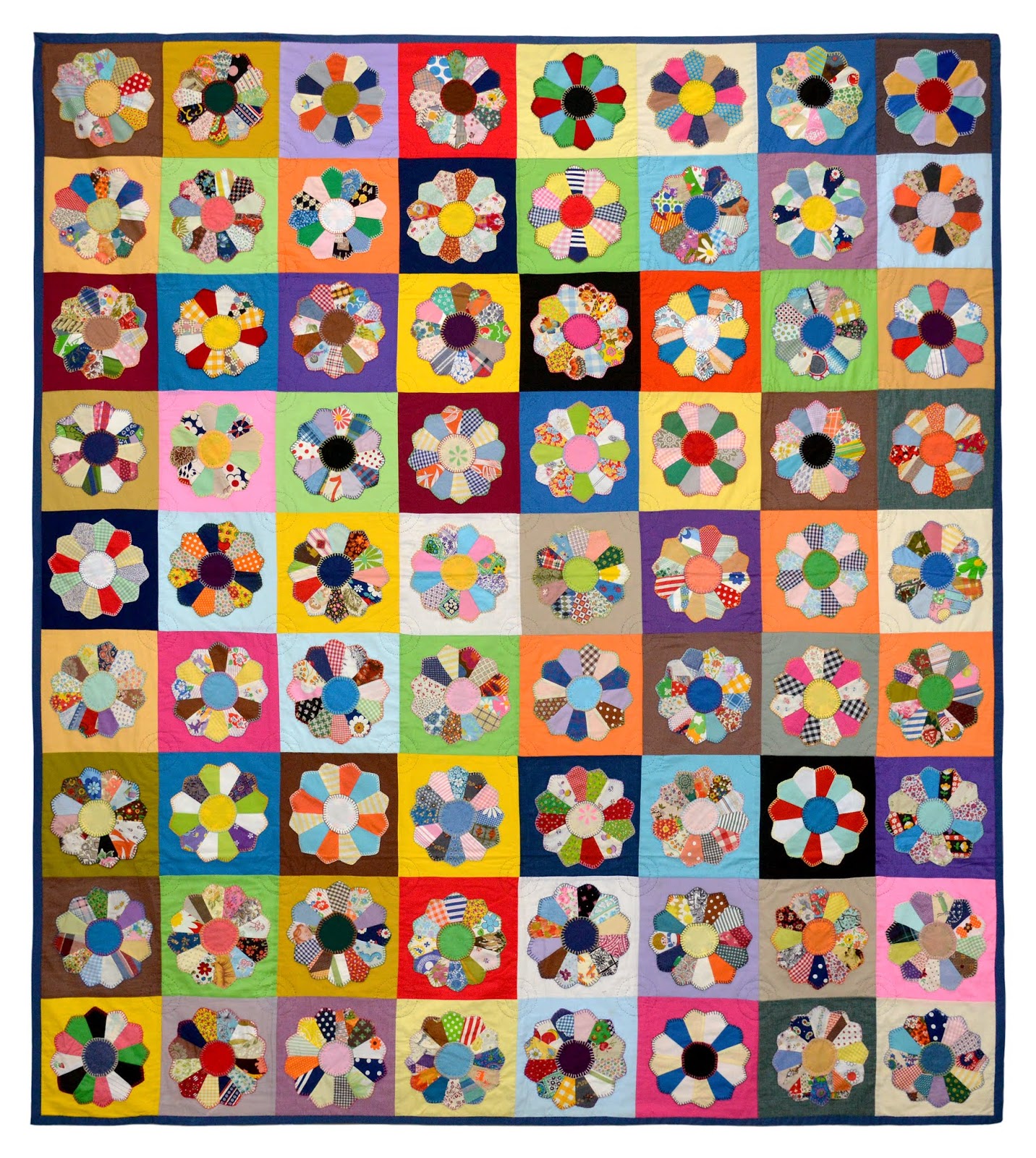
four blocks from a magnificent 1970s Dresden Plate quilted bedcover
I fell in love the moment I saw this colorful 1970s Dresden Plate quilted bedcover from Florida. It is so lively and bright. I want to know the maker.

It is constructed with 72 appliqued blocks, nine rows of eight blocks, backed and edge finished. It is sparsely handquilted and the blocks are pieced together. There is no batting, but it is finished as a quilted bedcover.


The maker changed threads often. There are many colors. Most of the blocks have more than one color thread.


Several of the blocks have bright colors such as lime green and fuchsia pink, and a few of the central circles have stylized floral details.


Dimensions are 74" x 88" so I am thinking it may have been made to fit a twin bed with a bedskirt when used as a bedspread.


Today it is more than a decorative bedcover. It is a work of art and beautifully preserved, exuberant object that speaks to a very specific time and place-- America in the 1970s. Even though it was less than 50 years ago, it seems like an eternity.

what's not to love?

An outstanding 1970s Dresden Plate. What's not to love?
In 2010, I bought my first vintage, 1970s quilt. By 2011, I was actively collecting 1970s quilts. I was head-over-heels in love with the quilts, and really...what's not to love?


In 2013, American Quilter Magazine published my first article about the quilts of the 1970s. The same year, Tracy Mooney of Generation Q Magazine called Victoria Findlay Wolfe and I "The Double Knit Twins" for collecting the quilts nobody else wanted. After that point, it was safe to say people wanted 1970s quilts, but there were still some skeptics and even a few critics.

2015: QuiltCon in Austin, Texas
2015: Exhibition at the Benton County Museum in Oregon
In 2015, I exhibited 1970s quilts at QuiltCon in Austin, Texas and had an exhibition of quilts from the 1970s at the Benton County Museum in Oregon. The same year, Quilters Newsletter published an article I wrote about the quilts of the 1970s. The critics were starting to take notice and acknowledge the quilts as part of quilt history, even if they didn't like polyester fabrics.


Last year (2017), I had an exhibit of 1970s polyester quilts at the International Quilt Study Center & Museum.


After all these important milestones, it seemed like everyone was on board. The world was finally showing an appreciation for the quilts of the 1970s. These quilts were the products of the great American quiltmaking revival of the 1970s, which revolved around the 1976 American Bicentennial. They occupied a very important space in quilt history and American history.


There are so many 1970s quilts in my collection now, I produced a self-published catalogue to keep track of them. It was a simple thing to show to anyone who might be interested in the quilts, particularly publishers and curators. Most of them are interested, but recently I met with the directors of the big quilt festival in Houston, and they told me I didn't need to take the book out of my bag. They didn't want to look at it. They also said I could show the quilts in other venues, but not theirs.

"no matter how far you go in life, never forget your roots."

Of course, I laughed. It was funny, even though it was terribly ironic. When it comes to the global quilt industry, a multi-billion-dollar industry involving tens of millions of Americans, all roads lead back to the 1970s. Had there not been a great American quiltmaking revival in the 1970s, there would be no big quilt festivals.


The moral of the story is: no matter how far you go in life, never forget your roots. The quilts of the 1970s are important cultural objects, speaking to an unprecedented surge in quiltmaking activity that led to a thriving, female-dominated industry. As we approach the 2026 Sestercentennial, we will have a unique opportunity to revisit this history. In my opinion, glancing back at the 1976 Bicentennial and celebrating the quilts of the 1970s will be the ultimate way of celebrating the rich heritage of American quiltmaking. 

Maine: Lobster Rolls & Whoopie Pies

Beautiful lobster roll at Morse's Cribstone Grill on Bailey Island, Maine 
Last week, Linda and I traveled to Maine to see Mom and my sister, Libby, who came up on Sunday to spend the day with us. We sampled as many lobster rolls and whoopie pies as we could manage. We also got some excellent clam chowder and fresh, local oysters.

Another amazing lobster roll at Schooner Landing in Damariscotta
Each lobster roll was a little different. The first one we got, from Morse's Cribstone Grill on Bailey Island, Maine, was very traditional-- chunks of succulent lobster tossed with a dollop of mayonnaise, served on a perfectly toasted, buttered, flat-sided hot dog roll with potato chips and a dill pickle on the side.

Our second lobster roll, from Schooner Landing Restaurant, was "clear meat" (not dressed) with butter and mayonnaise on the side. There was so much lobster, it was best to eat the large pieces of tail meat first, dipping them in the clarified butter, before diving in to the sandwich. Before we even got to the lobster rolls, we enjoyed some of the best New England clam chowder any of us ever had.


Our third lobster roll was at the Maine Lobster Shack in Portland. We enjoyed some beautiful Damariscotta River Oysters before the lobster roll arrived. The lobster roll was packed with claw meat, lightly dressed with an added sprinkling of chive, and served on a buttered, toasted roll. The batter dipped fries on the side were delicious, too.


Damariscotta River Oysters at the Maine Lobster Shack in Portland
Lobster roll at the Maine Lobster Shack in Portland, Maine
At the Sea Dog Brew Pub in Topsham, Maine
Lobster rolls #4 and #5 were made in Topsham and Brunswick, close to where Mom lives. #4 was at the Sea Dog Brew Pub. I've had their lobster rolls many times, and they are always delicious. The same is true for the lobster rolls made at Libby's Market in Brunswick. We got ours with lettuce, but the lettuce is optional. So is the mayo.

Libby's Market lobster roll-- it's simply delicious
We found another treat at Libby's. Whoopie pies! The whole time we were in Maine, we searched for the ultimate whoopie pie. There were many varieties, but I wanted the homemade ones-- the kind wrapped in Saran wrap, found in a little basket on the counter near the register at a mom and pop store. Libby's had two kinds, traditional chocolate and oatmeal, made by Heidi's Sweet Treats of Maine. They were perfect in every way.


OK, so we may have gained a few pounds on the trip to Maine, but we had a great time. Linda and I will be dreaming of lobster rolls and whoopie pies until our next visit.

Friday, June 1, 2018

vintage Hawaiian crazy patch bedspread

this crazy patch bedspread is approximately 88" x 93"

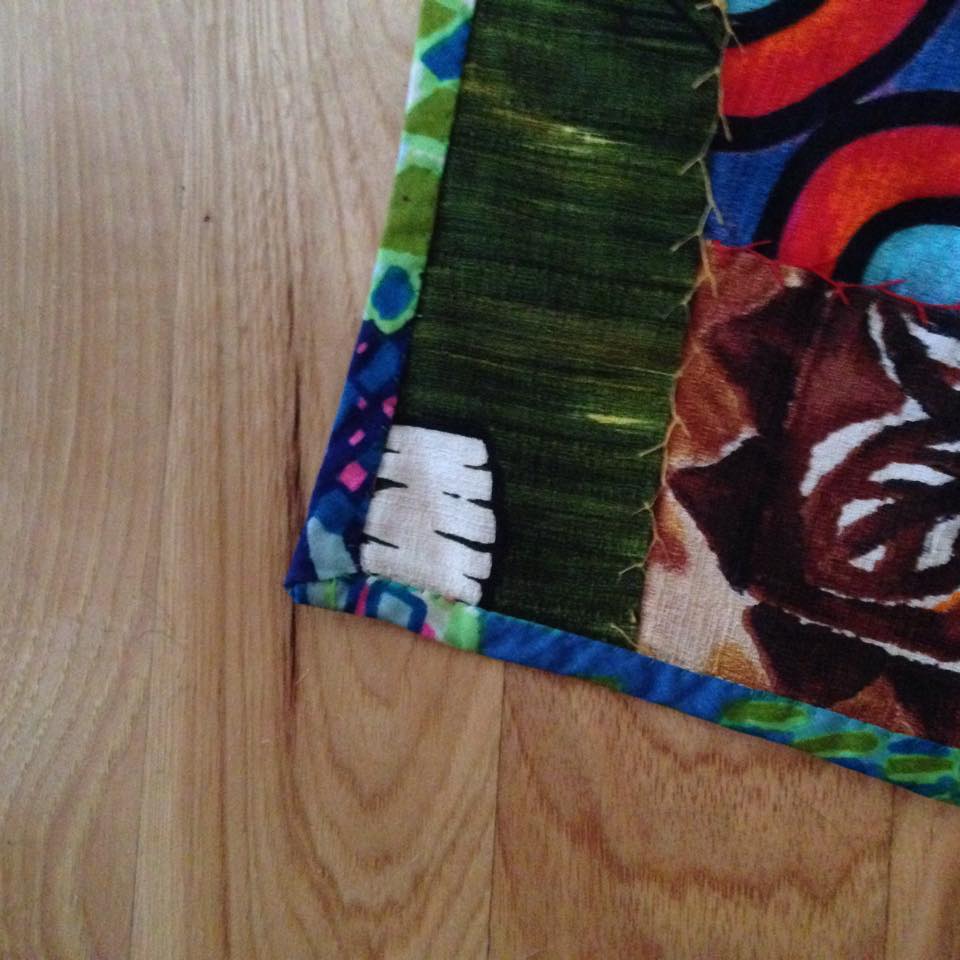
A fabulous vintage Hawaiian crazy patch bedspread just arrived from an eBay seller in Washington. It looks like something that could've migrated here from Hawaii because it has several of the attributes seen in other Hawaiian scrap quilts, such as foundation piecing on cloth, Hawaiian garment fabrics and an applied edge finish.


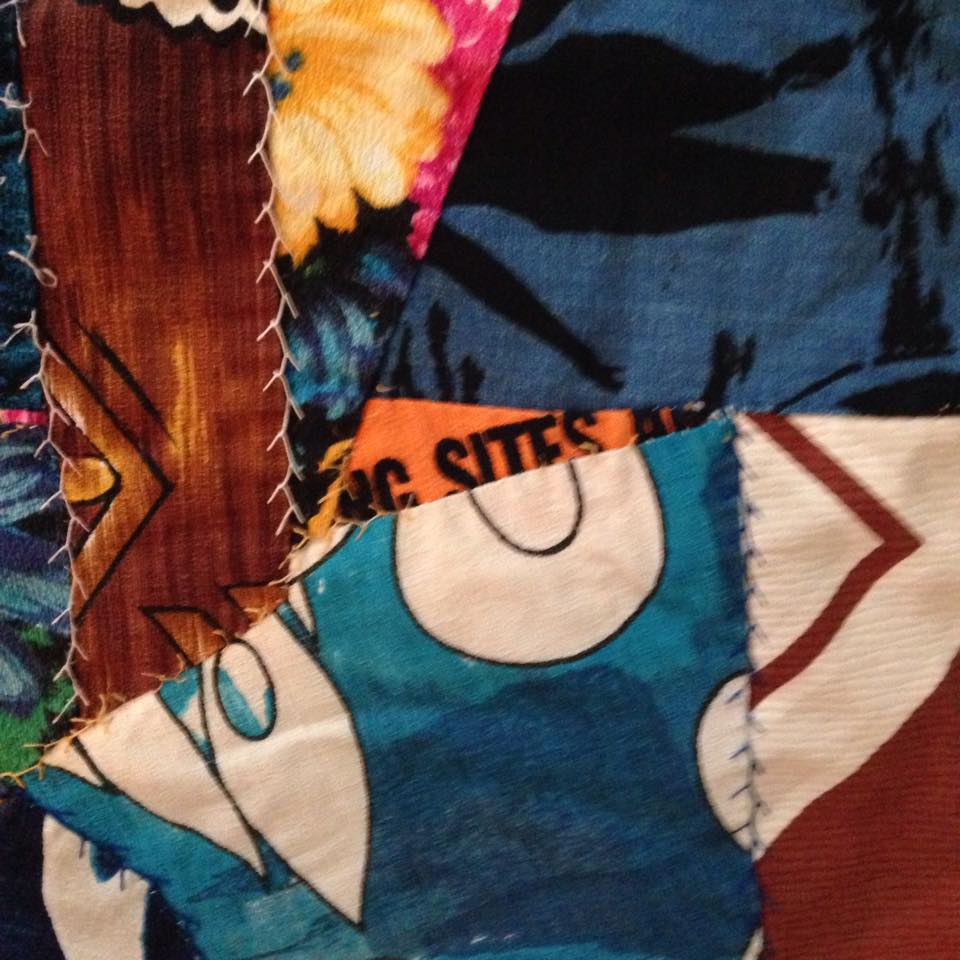
The patches are loosely feather stitched to cloth foundation, and a few pieces are coming loose. It shouldn't be too difficult to repair.


The fabrics include printed words and word fragments in several places. Wouldn't it be neat to find a large piece of it to see what it says?


Even though I think it's from Hawaii, I will probably say "found in Washington" and use the piece to discuss methods of construction seen in scrap quilts from Hawaii. The feather stitch seems a little unusual based on the objects I have collected, but I have seen it in more than one other quilt.

Friday, May 25, 2018

Coming Soon: 1970s Dresden Plate

This wildly colorful 1970s Dresden Plate quilt is something special.
Dresden Plate is an applique block pattern that became popular around the early 20th century, particularly in the 1930s. It is not a rare pattern by any stretch of the imagination. It is in fact one of the most popular 20th century quilt patterns, along with Double Wedding Ring and Grandmother's Flower Garden.


Several years ago, when I was doing photography for the statewide quilt documentation project here in Oregon we saw so many Dresden Plates, I almost wished I would never see another one.


Last night, I was glad I never really made that wish. I was looking around on eBay to pass the time before picking up my girlfriend from work, and discovered this wildly colorful, 1970s Dresden Plate quilt.


If it took more than five seconds to hit the "Buy It Now" button, I'd be surprised. This quilt is a head-turner. I wanted it the moment I saw it.


Dresden Plates are usually made of scrappy fabrics in a variety of mostly pastel colors and prints on a white background. If you search eBay and other places for Dresden Plates, you'll see a lot of them.


This example is a little outside the box. It was made during another prolific period in American quiltmaking-- the 1970s-- but rather than white, each block has a bright color as the background fabric.


Using colors in the background makes the quilt very lively. It's an eye dazzler. That's why I stopped in my tracks when I saw it.


The quilt includes a lot of handwork, such as hand quilted circles running through the intersecting points of each group of four blocks, and blanket stitching around the perimeter of each appliqued plate.


The wild use of color is very 1970s. I love seeing lime green, bright orange, royal blue and hot pink together.


The maker of the quilt must have had a lot of fun making it. No two blocks are the same, and that's part of the reason why it stands out.


I do not have a lot of Dresden Plate quilts in my collection. Years ago, when eBay first started and I was looking at thousands of images of quilts each day, Dresden Plates seemed like they were a dime a dozen.


I was looking for things that were much more unusual, rather than the same quilt thousands of people made.


The quilt is 74" x 88" and is coming from a seller in Florida. Looks like it is in very good condition. I can't wait to see it in person!