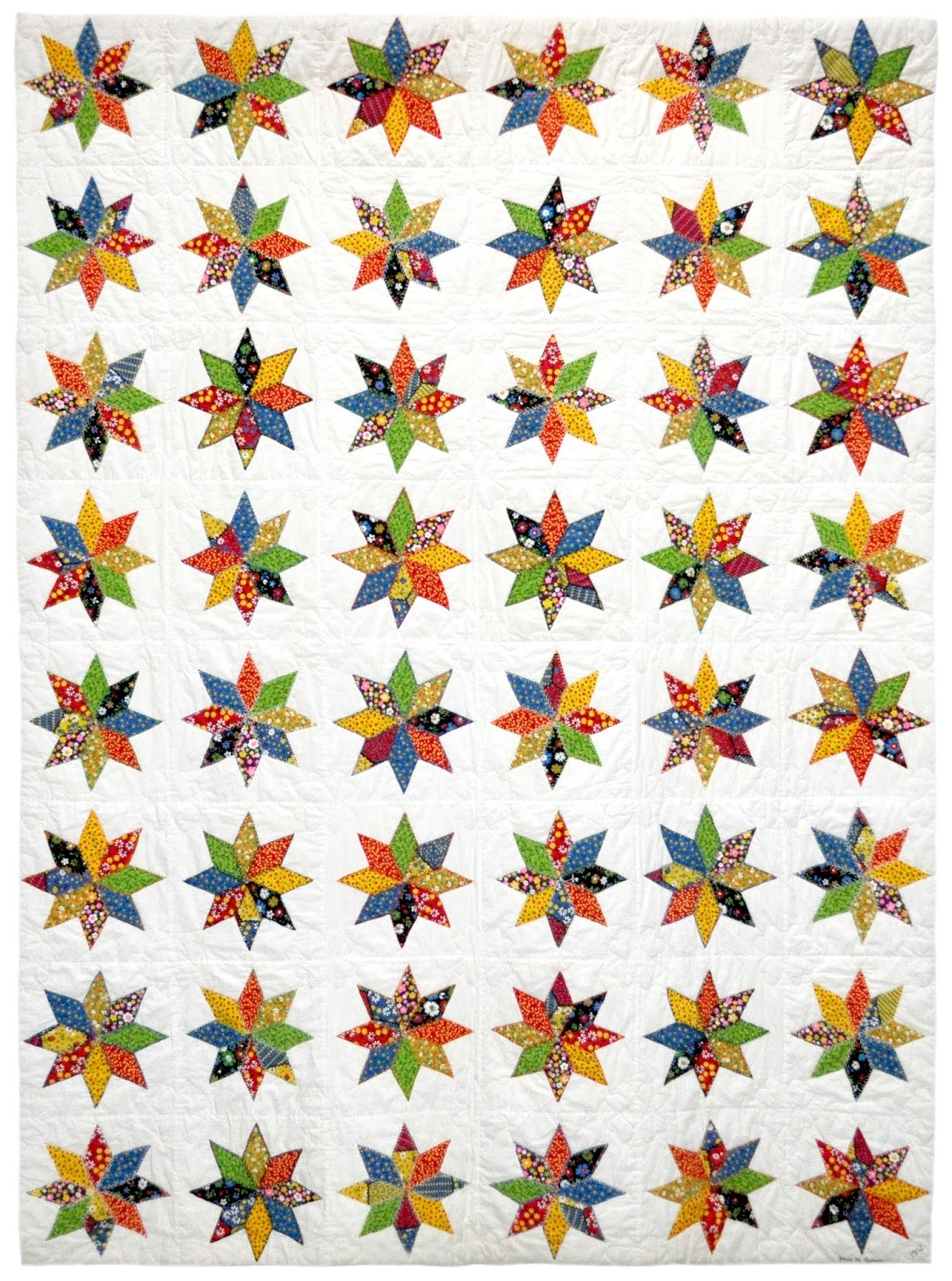
Wednesday, September 23, 2015

radiating polyester patchwork


This dynamic 1970s quilt came from an eBay seller in Ventura, California. It is 60" x 86", all polyester, and the repeat block design is a pieced fan radiating around an appliquéd central circle. The piecework includes four large wedges in the corners and eight smaller pieces in between. There are borders along three edges, and the sashing and border fabric is brown.


Like many of the other polyester quilts in my 1970s collection, this quilt includes a variety of polyester fabrics; solids and prints, woven and embossed. The fade-resistant polyester lets the true colors to show, something we do not always see in vintage quilts made of cottons. The palette is intriguing. Pink, purple, green, red, tan and brown all play well together; another surprising combination of colors that strangely works.


This quilt is part of an eye-opening group of barely-vintage quilts, currently on display in  "Modern Materials, Quilts of the 1970s" at the Benton County Museum in Philomath, Oregon. For more information about the exhibition, location, hours,  and other venues showing quilts during Quilt County 2015, click here.

Monday, September 21, 2015

circles in rectangles

circles in rectangles, polyester, unknown maker, New Mexico, 62" x 87"
This wonderful polyester quilt came from an eBay seller in New Mexico. It is 62" x 87", and the polyester top is machine pieced and raw-edge machine appliquéd.


The quilt is tied with black yarn, and backed with multicolor plaid canvas in madras colors, brought from back to front for binding. The design is a simple repeat with circles in the centers of rectangles. The appliqué is rough, but there is very little unraveling of the fray-and-fade-resistant polyester double knit.


Polyester was a versatile fabric in terms of patterns, textures and colors. A multitude of prints, weaves and vibrant colors appear in this quilt.


This quilt is part of an eye-opening group of barely-vintage quilts, currently on display in  "Modern Materials, Quilts of the 1970s" at the Benton County Museum in Philomath, Oregon. For more information about the exhibition, location, hours,  and other venues showing quilts during Quilt County 2015, click here.

Sunday, September 20, 2015

schooled in color


This quilt is one of my favorite 1970s quilts! I know. I say that about every quilt, but I really mean it with this one. Using hot pink and yellow ochre together harmoniously seems as likely as putting brown mustard on a piece of bubble gum and enjoying it.


The maker may have known all along it would work. Never in a million years would I have thought to put those colors together. Most surprising of all, it worked. The inclusion of blue and green, the substitution of beige for yellow ochre in places, even the heavy black sashing with red cornerstones worked. Usually I fare well when it comes to color, and could list credentials to back it up. This quilt schooled me in color.


The quilt came from Susan Nichols, a seller in Marshall, Texas. I bought it in May, 2013, and it is one of four quilts I bought from her between May and December that year. All of those quilts were bright, offbeat, included synthetics, and were made in the 1970s period.


There are nearly 850 pieces in the quilt including the borders. It is sparsely hand quilted at four stitches per inch, with rows of quilting separated by an inch or more-- approximately 25,000 quilting stitches. With the exception of maybe seven striped cotton patches, the quilt top is polyester double knit and the back is muslin brought from back to front for binding. There are borders on four sides, narrower on one edge; three of those borders were made with acrylic knit fabric and the other pieced with bright blue and green. Dimensions are 76" x 84".


This quilt is part of an eye-opening group of barely-vintage quilts, currently on display in  "Modern Materials, Quilts of the 1970s" at the Benton County Museum in Philomath, Oregon. For more information about the exhibition, location, hours,  and other venues showing quilts during Quilt County 2015, click here.

Saturday, September 19, 2015

Back to School Blog Hop: The Importance of Labels

wouldn't you love to know who made this quilt?
c. 1930s from Ohio

Welcome to the Hunter's Design Studio "Back to School" Blog Hop. This is my stop on the hop, and today's topic is The Importance of Labels.

wholecloth quilt, c. 1760-1800, unknown maker, eastern US

I have collected quilts since 1989. The quilts are mostly antique and vintage, and my collection includes more than 300 quilts made between 1760 and present day. Most of the quilts made before the turn of the 21st century have no labels, and their makers are unidentified.

silk diamonds, c. 1890 - more than 4,500 pieces, maker unknown
Let's stop and think about that for a minute. No labels. Makers unidentified. Something like that could never happen today...or could it?

This magnificent 1920s velvet Fans quilt from New York appeared
on the cover of "American Quilts, The Democratic Art, 1780-2007"
by Robert Shaw (first edition). The maker of the quilt is unknown.

Labels are largely absent from quilts made prior to the late 20th century. Quilts were made primarily for domestic purposes, and mostly made by women. Before the women's liberation movement, it was considered unladylike to be prideful. Taking too much pride in a quilt, even taking credit for it by labeling it, could have seemed unladylike. 

pieced quilt, c. 1800, Rhode Island - maker unknown

Quilts were decorative, utilitarian objects, home furnishings made for comfort and visual appeal. Sometimes they were made for special purposes such as a wedding or dowry. Still, they were not considered works of academic or fine art, such as a painting or sculpture. Academic art was a male-dominated tradition. Much has changed, fortunately!

early 1800s wholecloth quilt - maker unknown
Initials are quilted in to the quilt, but we do not know to whom they belonged

Quiltmakers managed to find subtle ways to include information in early quilts. Dates and initials were quilted in or embroidered, and those were the first signs of a desire to maintain an attribution with quilts.
pieced quilt, c. 1810, New England - maker unknown
the embroidered inscription is difficult to decipher, but it is there
There were also laundry marks, penned, stenciled and stamped ink inscriptions. often very difficult to decipher without supporting details. 

1840s Mariner's Compass, Tilton Family, Burlington County, NJ
The name Araminta Tilton is stamped on the back in ink.
(Don't miss the extremely fine piped binding)

Labeling quilts is common practice today, but before the late 20th century there were very few labels seen on quilts. As quiltmaking evolved to include other types of quilts such as fundraising and commemorative quilts, information in the form of inked or embroidered inscriptions would appear as part of the design.

1931 American Legion Auxiliary Quilt, Salem, Oregon

Some quilts, such as the 1931 American Legion Auxiliary Quilt from Salem, Oregon, included a lot of information in the inscriptions. Even though the quilt did not have a label, it had enough information for thorough research. To read more about this incredible quilt - click here.

a nice, simple example of an embroidered quilt label
There is more than one way to label a quilt, but the best way is whatever is most permanent. Indelible fabric markers can work, although they sometimes fade with repeated washing and exposure to light. Quilting in the information is also good, as long as it is legible. Embroidery is very good, although it can be costly if you do not do it yourself. Most labels are stitched on to the back of the completed quilt, but if you piece the label into the back, it's not going anywhere!

"Oregon July" 2014 by Bill Volckening, quilted by Jolene Knight

In addition to collecting, I sometimes make quilts. "Oregon July" 2014 is my first large quilt, and it represents my story of falling in love with Oregon. Since the quilt was special to me, I wanted a really good label-- but that took some thought because it is a reversible quilt.

The reverse side of "Oregon July"

When preparing the quilt for display, I thought about viewing the quilt from both sides and wanted a label that wouldn't interrupt the picture too much. So, I had a professionally-printed label made. Friends Gail and Gregg Weiss at Phantom Chicken did a wonderful job with it.


If you hang around quilters long enough, you will hear people say, "a quilt is not finished until it has a label on the back." I think I may have heard Sam Hunter say it more than once. :) Many quilters label their work today, but there are still many who do not. It is very important to label quilts, and I hope labeling is a practice all quiltmakers will adopt and maintain.

c. 1860s applique quilt, maker unknown

When I look at old quilts and see all the work that went into them, it is sad not to have any information about the origins, other than what we can glean from the quilt's attributes. Labeling your quilt is an opportunity to give a shout-out to friends, family and even quilt historians in the future. So put a label on it, and keep your quilt's story alive!

###

Thank you, Sam Hunter for including me in this wonderful blog hop. Next up, (Sept 20): 


Jessica Darling of Jessica Darling – How to Make a Quilt Back.

Friday, September 18, 2015

"Sweet Little Calicoes"


"Sweet little calicoes" is a term I thought I'd invented. When describing Janis Pearson's 1972 Star Quilt during my special exhibit tours at QuiltCon 2015, I referred to the nice selection of sweet little calicoes. After the tour, I ran into Carolyn Ducey, curator of collections for the International Quilt Study Center & Museum. We were drawn to one of the 1970s quilts, and the words "sweet little calicoes" came out of her mouth. But she hadn't been on the tour.


Laughing, I admitted calling them "sweet little calicoes" as well. Of course, it is not the endorsed, academic nomenclature. It's just what Carolyn and I call the fabrics, and we were in complete agreement. I think it's because they are sweet; and you could call the mostly-small-scale prints little. 


I have blogged about Janis Pearson's Star Quilt in the past, but earlier this week I saw Janis at the Northwest Quilters meeting, and got another nugget of information. She thought she'd found the fabrics at the Singer shop in Portland, one of the few shops carrying cottons you could use for quilting at the time. 


The multicolor calicoes look like they belong together. The blue, with its pops of yellow, goes with the yellow. The red fabric goes with the yellow fabric because each has flowers of the other's dominant color. It could have been one fabric line, but not necessarily, since calicoes came in a multitude of colors. The Double Wedding Ring quilt from Colorado, seen in yesterday's blog, has an even larger selection.


Using so many colors throughout a design could easily be disharmonious, but not with the sweet little calicoes of the 1970s. Rather than assaulting you with color, these fabrics dance. In today's lingo, they play well together.


Janis Pearson's Star Quilt is part of an eye-opening group of barely-vintage quilts, currently on display in  "Modern Materials, Quilts of the 1970s" at the Benton County Museum in Philomath, Oregon. For more information about the exhibition, location, hours,  and other venues showing quilts during Quilt County 2015, click here.

Thursday, September 17, 2015

1970s Double Wedding Ring Quilts

wild and wonky: Double Wedding Ring, unknown maker, Texas, c. 1975, 64" x 84"
Take a good look at this 1970s Double Wedding Ring quilt. There's a lot going on! The pattern appears and disappears in a riot of fabrics, as if layers were peeled away, revealing what was underneath. It's an innovative idea for a Double Wedding Ring, a quilt often made with more of a traditional look. Because the pieced arcs can be challenging, most quilters let their arcs stand out.


The quilt came from an eBay seller in Texas during a flurry of activity a couple years ago, when 1970s quilts began to flood the market. Soon after, things slowed down. Perhaps people realized they should hold on to these offbeat gems, wait until the market hit a peak. Regardless, I got a lot of great quilts when they were available. Two other Double Wedding Rings are part of my 1970s group. One is fairly traditional, and the other more offbeat.

Double Wedding Ring, unknown maker, Colorado, c. 1975, 91" x 91"
This more traditional looking 1970s Double Wedding Ring quilt came from an eBay seller in Colorado. It is cotton, possibly with some cotton/polyester blend fabric in the mix. The quilt is a time capsule of 1970s print calicoes. It seems like every color available made it in to this quilt. Although the quilt is completely scrappy, using every color everywhere in the quilt creates a sense of harmony.

Double Wedding Ring, unknown maker, California, c. 1970, 90" x 90"
The third 1970s Double Wedding Ring is somewhere in between the first two. It is wild, but there is also structure. The quilt originally came from an estate in Altadena, California; one of two related polyester double knit Double Wedding Ring quilts. Both were sold through The Quilt Complex.

Double Wedding Ring, unknown maker, California, c. 1970, 104" x 106"
collection of Roderick Kiracofe
International Quilt Study Center Museum, Lincoln, Nebraska
photo courtesy of Roderick Kiracofe

The other polyester Double Wedding Ring went to the collection of Roderick Kiracofe, and is currently on display in "The Extraordinary Made from the Ordinary" at the International Quilt Study Center Museum in Lincoln, Nebraska. Before Lincoln, it was on display at the Sonoma Valley Museum of Art. Roderick has been busy! Also showing now, an exhibition he guest curated at San Jose Museum of Quilts & Textiles called "Found/Made".

side-by-side - the sibling quilts, virtually reunited
The use of many colors gives these two quilts a lot of movement. They are more visually challenging than the quilt from Colorado, but the solid color background fabrics let the pieced arcs stand out more than the wild and wonky quilt from Texas.


A variety of fabrics appear in the wild and wonky quilt from Texas, cottons and a few synthetics. It is 64" x 84" and is completely hand pieced and hand quilted. The work is a bit rough, but precision may not have been the top priority; it sure wasn't with the fabric selection. That's what I love about it.


The wild and wonky Texas Double Wedding Ring Quilt is part of an eye-opening group of barely-vintage quilts, currently on display in  "Modern Materials, Quilts of the 1970s" at the Benton County Museum in Philomath, Oregon. For more information about the exhibition, location, hours,  and other venues showing quilts during Quilt County 2015, click here.

Wednesday, September 16, 2015

Thank You, Generation Q!

photo by Lisa Lauch
The September/October 2015 issue of Generation Q Magazine is now available, and it includes a visit to my home in Portland, Oregon. Melissa Thompson Maher wrote article and Lisa Lauch took photos. They did a wonderful job! Lulu even made an appearance.


It was fun to hear my home described as a "quiltified space" and "a version of q-heaven" because I'd never thought of it that way. Sure there are quilts everywhere, but that's normal. Right now I've got such a stash, I'm not buying too much, as I usually do in the Fall season. Instead, I'm working on a variety of projects and having a blast!


When asked what my favorite part of the house was, I said my kitchen. It was remodeled in 2008, and I selected all the finishes to give the space a Portland vibe.


When we did the interview, I could only come up with egg dishes for some reason -{ LOL @ me }- but I cook pretty much everything; slow braised carnitas, hand tossed thin crust pizza, steamed mussels, and of course lobster!!

Lobster for Thanksgiving? Yes please!!
I have to keep leafy greens in the refrigerator, because Lulu likes to eat them. If she knows there are greens in the house, she gallops over every time I'm near the fridge. The cat is hilarious.


There was so much to talk about, and so many great photos, Teri Lucas posted a bonus blog, Quarters: A Bit More of Bill. To view the blog, click here.


Many thanks to Generation Q Magazine and its staff for a job well done. I should mention it was a lot of fun being in the same issue as friends who were in other articles. Generation Q Magazine is available in shops and online. For more information, click here.