Thursday, September 7, 2017

The stuff of legends, part 2: "Hawaiian" quilts

Hawaiian quiltmaking, particularly the promotion and commodification of a singular, regional style, is the stuff of legends. 

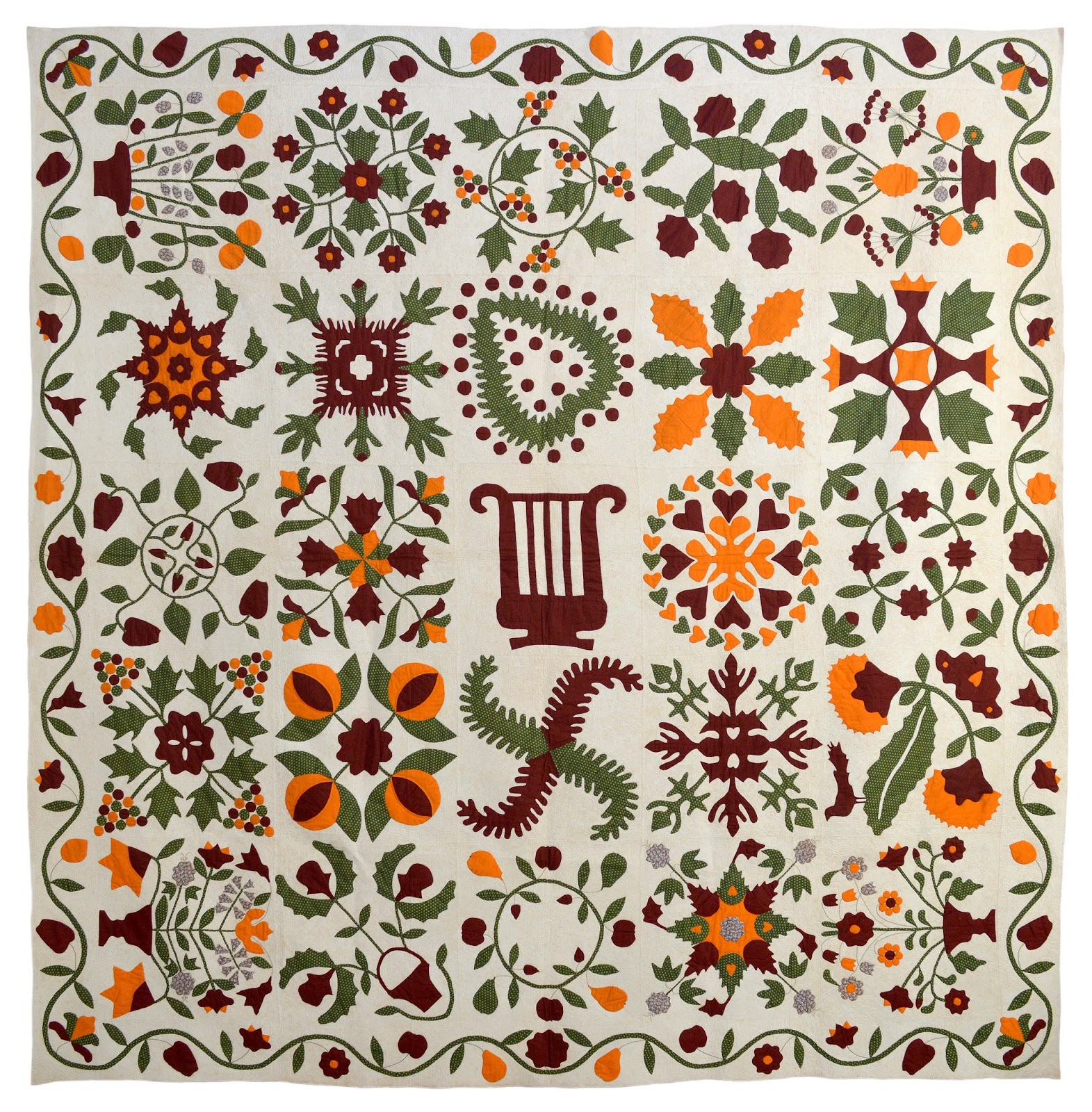
If you pick up most any book about Hawaiian quiltmaking, there will be lots of quilts made in a similar manner. They are applique quilts, predominately solid fabrics, two-color, with large, symmetrical paper cut botanical snowflake designs and echo quilting.


Hawaiian quiltmaking, particularly the promotion and commodification of a singular, regional style, is the stuff of legends. If it sounds vaguely familiar, think back to "part 1" - the promotion and commodification of a singular style, improvisation, as the "African-American" style of quiltmaking. To read more on that topic, click here.
Wilson family quilt, c. 1930, Kailua, Hawaii
If you travel to Hawaii, you will see appliqué quilts and pillows for sale in gift shops. A lot of those objects are made outside of Hawaii, in places such as the Philippines, and are made with the sole intent of satisfying the tourist market. In that regard, a lot of "Hawaiian" quilts are not even Hawaiian anymore.

"Hawaiian" style quilt made in the Philippines
The symmetrical, botanical designs are directly related to scherenschnitte patchwork found in Pennsylvania and surrounding areas around the time missionaries were present in Hawaii.

block from an 1850s quilt made in West Virginia
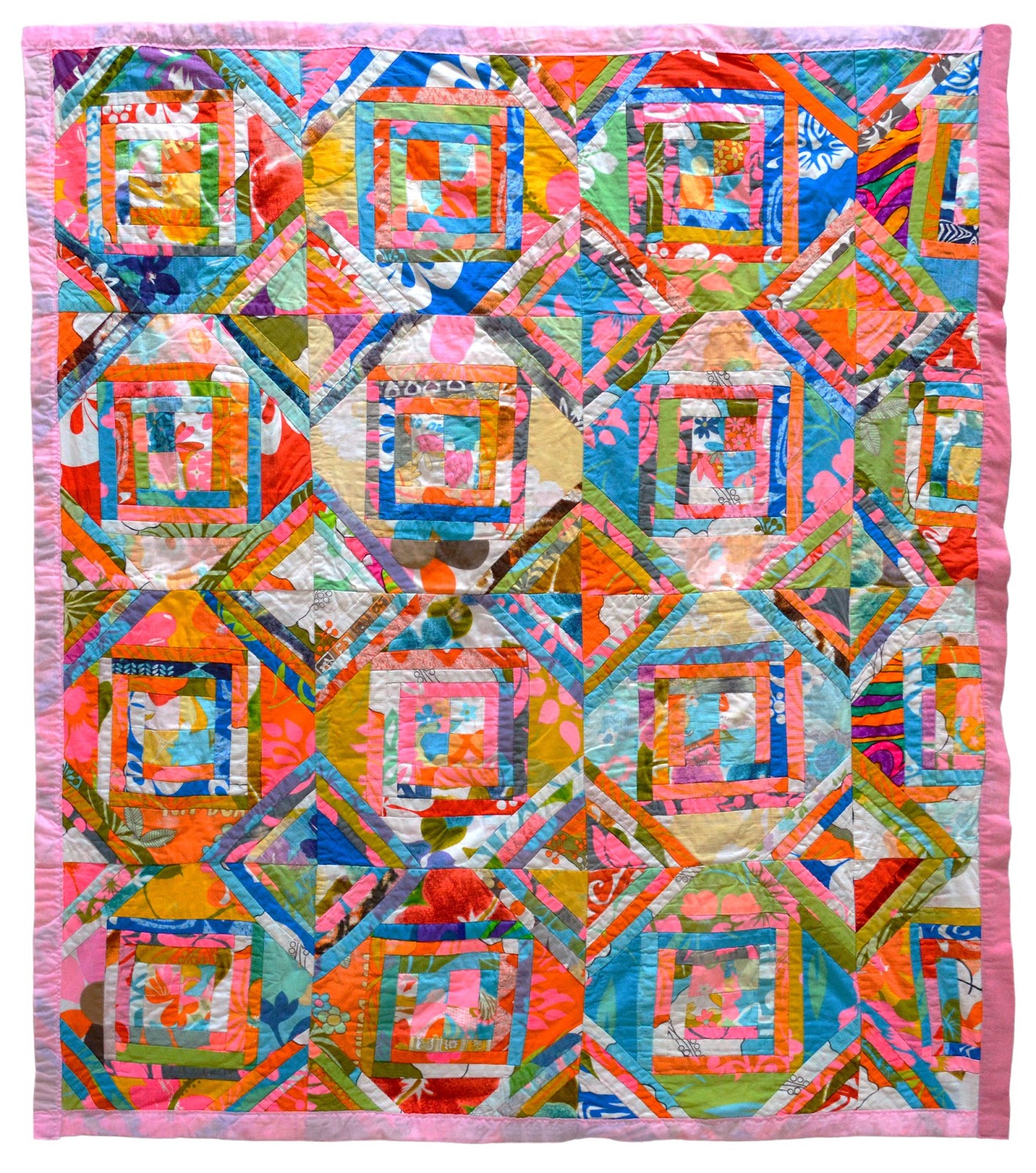
In light of the general acceptance of the idea that "Hawaiian" quilts are echo-quilted applique quilts, it is intriguing to discover a separate tradition of purely Hawaiian quilts-- Hawaiian scrap quilts.

Hawaiian scrap quilt, c. 1960
Scrap quilts cleverly make use of cutaway scraps from the Hawaiian garment industry, also the source of aloha shirts and muumuus.

Hawaiian scrap quilt, c. 1960

The quilts represent more than a spin-off on mainland trends. Consistently, cloth foundation piecing such as string piecing appears in the tops. A large number of the scrap quilts are backed but have no batting. Most are not tied or quilted.

Hawaiian scrap quilt, c. 1970

Some are bedspreads, with an edge finish but no backing. All of them are time capsules of the Hawaiian garment industry, beautifully presenting and preserving the scrap fabrics. They are vibrant, and combine an unlimited number of hot colors in a delightfully carefree way.

Hawaiian scrap quilt top, c. 1970
Geometric motifs appear and reappear, such as alternating, string-pieced blocks forming squares on point, or diamonds. The narrow strips of fabric required to create these designs are exactly the type of scraps the garment industry would produce as a byproduct. The repeating geometric motifs are reminiscent of those seen on a much smaller scale in kapa cloth.
Hawaiian scrap quilt top, c. 1970
Crazy patchwork and crazy blocks frequently surface, as well. The process of making these quilts offers a reasonable way to use irregular scraps to create lively but cohesive designs.

Hawaiian scrap quilt, c. 1970
Hawaiian scrap quilts are rooted in Hawaiian history, perhaps to a greater degree than the applique quilts. In addition to the geometric repeats and their relationship with kapa cloth, the crazy, cloth foundation pieced patchwork is connected to a royal object called The Queen's Quilt.

Cooke Family Quilt, c. 1890, Hawaii
The Queen's Quilt was started in 1895 by Queen Liliuokalani and her attendants while she was imprisoned at Iolani Palace during the overthrow of the Hawaiian Kingdom. This quilt, also the stuff of legends, disappeared for many years following Liliuokalani's death in 1917, but its story was passed down through the generations.


It is unclear where Liliuokalani got her inspiration to make a crazy quilt, but recently another Victorian era crazy quilt surfaced, and it belonged to the Cooke Family, the educators of young Liliuokalani at the Chiefs' Children's School. The Cooke Family Quilt raises questions and could possibly provide answers regarding where Liliuokalani could have learned about crazy quilts.
Hawaiian scrap quilt, c. 1970
The discovery of Hawaiian scrap quilts, both as distinct regional tradition and as an oeuvre of collectible, leads to a greater understanding of Hawaiian quilting heritage and Hawaiian culture. Tourism was certainly a big factor, and the repeating geometric elements seen in kapa cloth, foundation-pieced crazy patchwork seen in The Queen's Quilt and fabrics seen in the garments show the strong connection to Hawaiian history.

Monday, September 4, 2017

The stuff of legends, part 1: "African-American" style

why is it so problematic to assign labels to quilts?
Future quilt historians will have their work cut out for them, and it has everything to do with both benevolent and unfavorable efforts of their predecessors. If I could say one thing to future generations of quilt detectives it would be, "Ask a lot of questions about the quality of the information."

"Ask a lot of questions about the quality of the information."

The "stacked bars" quilt (pictured at top) is in my second book, "Modern Roots, Today's Quilts from Yesterday's Inspiration" (2016, C&T/Stash Books). In the book, I compare the quilt to one made by Jessie Pettway of Gee's Bend, Alabama. Pettway's quilt famously appeared on U.S. Postal Service stamps in 2006.


Given the stylistic similarities between the two quilts, it would be tempting to link them in other ways. The seller of my quilt called it African-American despite having no information about the maker. I bought the quilt, but not the story.

the real deal: a quilt made by Lucy Mingo, Gee's Bend, Alabama, 1979
Descriptions of quilts can be the stuff of legends, and that's the crux of the issue with provenance. Is the information available, or not? And if information is available, is it true? What is the source? 


In 2002, "The Quilts of Gee's Bend" caused a sensation at the Whitney Museum of American Art, when New York Times art critic Michael Kimmelman called the quilts "some of the most miraculous works of modern art America has produced." That's when the sellers started getting dollar signs in their eyes. 


"You can't judge a book by its cover."

It was a perfect storm for growing misconceptions about quiltmakers of color in America. The most common misconception was that all African-American quilts looked like the quilts of Gee's Bend. In other words, improvisational, abstract quilts. The impicit message was the quilts represented a certain level of sewing skill among African-Americans. Very far from the truth, but others latched on to the misconception.


Prominent collectors published and exhibited vintage quilts with no provenance and attributed them as African-American, falsely identifying improvisational style as purely African-American. I saw an exhibition of quilts from the collection of Corrine Riley at the Bellevue Museum of Art in 2014, and can recall only one quilt in the exhibition of approximately 50 objects with maker's information. Problematic, to say the least. 


Improvisational style in American quilts did not originate in Gee's Bend, even though the quiltmakers of Gee's Bend had tremendous success with it. The rise of improvisational quiltmaking was more closely connected to the development of the textile and garment industries in America. I wrote about it in an article in QuiltCon Magazine in 2015. 

"Listen to the quilt! It will tell you all there is to know."

Sarah Nixon's quilt, c. 1935
Another quilt in my "Modern Roots" book is a blue and white "Indiana Puzzle" made by Sarah Nixon of Verona, New Jersey around 1935. Nixon, an African-American woman who was a housekeeper, made the quilt for the cute little girl who lived in the neighborhood, my Mom. It is worthy of note but almost goes without saying, Nixon's quilt is not improvisational.

Carolyn Mazloomi's quilt
Narrative, storytelling quilts seem to represent a bigger piece of the pie when it comes to African-American quiltmaking today. There is currently only one example in my collection, and that is "Spirit of Forgiveness" by Carolyn Mazloomi. Recently, Carolyn donated a large group of African-American quilts she collected to the Michigan State University Museum. A majority of the quilts were pictorial and told stories. Further enhancing their tremendous cultural value, the quilts also documented African-American history, information not found in U.S. History curriculum.

improvisational quilt, unknown maker, c. 1920-1940
Considering the number of loosely attributed, "African-American" quilts, historians could face an uphill battle. I hope there will be others like myself who come along and ask, "Is that true?" Our practice, and the burgeoning field of quilt history can embody all the available information without having it become the stuff of legends. As I like to say, "Listen to the quilt! It will tell you all there is to know."

Sunday, September 3, 2017

quilts deserve to be called masterpieces

The Tilton Family Quilt, c. 1840, Burlington County, New Jersey
"Masterpiece" is a word I sometimes use when speaking about the quilts in my collection. The first person I remember saying a quilt was a masterpiece was Shelly Zegart. Her book, "American Quilt Collections: Antique Quilt Masterpieces" was the first quilt book I ever saw.


I love how Shelly talks about quilts the way others might discuss paintings or sculptures, the objects canonized by art history tomes. Back in 1984, when I entered Rhode Island School of Design as a freshman, we were required to take art history as one of the five courses in the Freshman Foundation. The other courses were drawing, two-dimensional design, three-dimensional design and English composition and literature.

my first antique quilt: unknown maker, Kentucky, c. 1850
By 1989, the year I met Shelly in New York and bought my first quilt from her, I fully understood what a masterpiece was. Although I never heard the term used to describe a quilt, I knew exactly what she meant. Along with this new-to-me concept came a sad realization. Quilts were not part of the conversation in art history curriculum.

c. 1800 quilt from Rhode Island
Wouldn't it be marvelous to attend a top school such as Rhode Island School of Design and have quilts, such as this early star quilt from Rhode Island be included in the conversation about the history of art?


A masterpiece is a work of outstanding artistry, skill, or workmanship. In some cases it is also representative of an artist's or craftsperson's best work. The latter definition could be problematic with quilts made by unknown makers, but when you see a lot of quilts the masterpieces tend to jump out.

an 1840s masterpiece from New England
For me, a masterpiece can also be an outstanding example of originality or creativity, even if it does not represent a high level of skill or refined workmanship. I love quilts that are one-of-a-kind originals, regardless of the level of skill involved.

one-of-a-kind original: unknown maker, New York, c. 1920
Perfection may have been the goal. It was far from the end-result a lot of the time, but the flaws always revealed the people behind the work. Quilts were handmade objects, and if they involved machines, you could still see the hand of the persons operating the machines.

another one-of-a-kind original: unknown maker, Ohio, c. 1930
On the other side of the coin, a masterpiece can also be made from a known or published pattern, such as the Giant Dahlia Quilt, a Hubert ver Mehren design. The maker of the quilt in my collection is unknown, and perhaps there was more than one maker.

Giant Dahlia Quilt, c. 1930
It was no small feat to make this quilt. The level of workmanship is clear, and the maker(s) followed the rules, creating exactly what the pattern specified, all the way down to the quilting design. If ver Mehren had made one of these quilts rather than simply drafting the design, his Giant Dahlia Quilt would look exactly like this one.

a masterpiece quilt in poor condition
We often think of masterpieces as well-preserved objects, but that is not always the case. Many years ago, when I found a pieced quilt of the "New York Beauty" motif and it had two large chunks missing, I realized it was still a masterpiece. It was simply a masterpiece quilt in poor condition.

Owls, unknown maker, Ohio, c. 1975
Quilts deserve to be called masterpieces. Quilts deserve to be included in art history curriculum and every major museum. The presence of quilts would aptly address the sharp, patriarchal vantage points in those arenas. Quiltmaking tradition represents a long, unbroken thread of predominately women's creative expression. Referring to quilts as masterpieces is a good place to start. 

Saturday, September 2, 2017

Four Centuries of Outstanding Quilts

middle 19th century masterpiece quilt from Kentucky
I started collecting in 1989, when I was 23, so I have collected quilts for more than half my life. My collection includes four centuries of outstanding quilts, with examples from the 18th, 19th, 20th and 21st centuries.

late 18th century wholecloth blue resist quilt - a rare find
 The 18th century quilts are hardest to find, and it took me a long time to develop an appreciation for them. The quilts are often elegant, such as the blue resist wholecloth quilt made in the 1760 to 1800 period. Others are rather drab but include exquisite quilting designs such as the wholecloth wool quilts found in New England.

late 18th century wholecloth wool quilt from New England
Quilts of the 19th century were my primary focus when I began collecting. These quilts are 100 years old or older, bona fide antiques.

middle to late 19th century quilt from Kentucky
At first, I was mostly interested in pieced quilts and focused on the motif known today as New York Beauty. I wrote all about it in my first book, "New York Beauty, Quilts from the Volckening Collection" (2015 Quiltmania, France).


As the collection grew, it evolved. Still, after 20 years of collecting, very few people knew what I'd been doing. I looked for unique things, especially because the quilts functioned as wall art in my home. Seek, and you shall find!
Victorian period silk pieced quilt, eastern United States
late 19th century hexagon pictorial quilt, Pennsylvania
At a certain point, I ventured into appliqué quilts, and found some really great ones. I am always struck by the beauty of the botanical motifs and the level of sewing skill. Much originality, too.

middle 19th century masterpiece album quilt from West Virginia
middle 19th century appliqué quilt from Kentucky
After seeing the Quilts of Gee's Bend exhibition at the Whitney in 2002, I started looking at more improvisational quilts, and eventually turned my attention to the 20th century.

wool quilt dated 1937, eastern US (possibly Pennsylvania)
One of my first acquisitions from the 20th century was a wool airplanes quilt, dated 1937. It is on the cover of my second book, "Modern Roots, Today's Quilts from Yesterday's Inspiration" (2016, Stash Books), along with a stunning new quilt made by Christine Turner.

Christine Turner's quilt, inspired by the quilt in my collection
From the beginning of my time collecting, I had an eye on modernism. It was what initially drew me to the quilts...the graphic visual qualities of the objects. The people who made these quilts, mostly women, may have had ordinary lives, but their work was extraordinary. I felt like I was like looking at modern art predicted.

strikingly modern late 19th century quilt found in Texas
late 19th / early 20th century quilt, also incredibly modern
In more recent years, my focus has been a nearly legendary period in American quiltmaking, the 1970s. More than 150 quilts in my collection are from this period. Many of them are offbeat and made of ultra modern materials, such as polyester double knit. Since barely anyone else was collecting these quilts at the time, I had a field day. I found the best stuff, because I was looking.

1970s polyester quilt from Louisiana
1970s polyester quilt from Oregon
Everyone loves a good spinoff, and there was an important one with the 1970s quilts. It was a whole regional tradition, completely unexplored and untouched by researchers and quilt historians. It was also a mythbuster.

1970s Hawaiian scrap quilt
Scrap quilts from Hawaii were part of quilt history. Telling people about it was one of the highlights of my incredible quilt journey. The myth about Hawaiians making one distinct style of quilt was officially busted. The austere, symmetrical, botanical, two-color applique quilts were not the only quilts made by Hawaiians.

1970s Hawaiian scrap quilt
The thrilling thing about the Hawaiian scrap quilts was the manner in which they busted the myth. These quilts looked nothing like the applique quilts, but they were certainly Hawaiian looking in every possible way. The sense of color and pure exuberance was unmistakable, and the search for these quilts took me to Oahu in January. I've only just begun to talk about Hawaiian scrap quilts.

1990s quilt by Andrea Balosky
Coincidentally, Hawaiian born artist Andrea Balosky gave me an appreciation for the work of quiltmakers in the last two decades of the 20th century. I have not collected much work from this period, but recently acquired a stunning quilt made in 1984 by master quilter Libby Lehman.

1984 quilt by Libby Lehman
The 21st century was and is new territory from a collector's point of view. What quilts will be collectible 50 or 100 years from now? It's really anybody's guess, but if you asked me, I would say it boils down to originality and spirit.

a 21st century medallion made by officers of Portland Modern Quilt Guild
Probably the best thing about collecting today's quilts is knowing the people who made them. That is exactly the case with the medallion quilt I won in a Portland Modern Quilt Guild holiday raffle. The women who made the quilt ran the guild that year, and each one is a gem.

Modern Domestic's Row-By-Row block
Cath Hall was one of the creators of the PMQG medallion. She also had a big hand in the Modern Domestic Row-By-Row block with the water glasses. One fine day, she graciously handed me the store sample she made. I adore her.

Green Cross series quilt by Gail Weiss
Speaking of people I adore, Gail Weiss, also a member of Portland Modern, made me weak in the knees with her Green Cross series. I had the good fortune of photographing all five of them in my studio. Even luckier, I own one of them.
"The Best" Yvonne Porcella
Quilts are memory objects, too. I met Yvonne Porcella at the San Jose Museum of Quilts & Textiles in 2013, when the museum was filled "New York Beauty" quilts from my collection. I was full of joy because I got to meet Yvonne. And now that she's passed away, I am grateful to have one of her quilts from a Quilt Alliance auction a few years ago.

"Spirit of Forgiveness" by Carolyn Mazloomi
Quilts have the power to tell stories, and that's exactly what this recent addition to the collection from Carolyn Mazloomi accomplishes. It is called "Spirit of Forgiveness" and tells the story of the atonement of Adriaan Johannes Vlok. I blogged about it here

"Fruity Beauty" by Bill Volckening, quilting by Jolene Knight
So, that is a quick tour through four centuries of outstanding quilts. With more than 450 in my collection, it is hard to pick favorites. Every once in a while, I make a quilt, too. The ones in this blog represent an amazing journey, and it's not over yet. Where will it lead? Who knows? But it'll sure be colorful and full of love.