Saturday, September 8, 2018

Cotton: The American Civil War & Politics Today

"Green Cross Series #4" 2014 by Gail Weiss, Portland, Oregon
In yesterday's blog post, I spoke about the everyday marginalization of American quiltmaking. A comment from my friend Gail Weiss reminded me, there is more to say about quiltmaking today. But first, let's spend a little more time on yesterday.

chintz counterpane, Achsah Goodwin Wilkins, Baltimore,  c. 1825
donated to the D.A.R. Museum, Washington, D.C.
Achsah Goodwin Wilkins (1775-1853) was an affluent, white woman who lived in Baltimore, Maryland. She was involved with making elegant bedcovers using expensive, imported fabrics from Europe, and African-American women as laborers. Her fanciful, floral counterpanes were made for well-appointed homes such as her own.


You may ask, why do I keep talking about Achsah Goodwin Wilkins? She died 165 years ago.

Map of the Continental United States, color coded to show 1861 status

Cotton was a precious commodity in the first half of the 19th century. According to Henry Louis Gates, Jr., who wrote an article appearing on the PBS web site called "Why Was Cotton 'King'?", cotton was "one of the world’s first luxury commodities, after sugar and tobacco..." It was also "...the commodity whose production most dramatically turned millions of black human beings in the United States themselves into commodities," said Gates, Jr. 


The American Civil War was fought in the United States from 1861-1865. As a result of the longstanding controversy over slavery, the war broke out in April, 1861. Confederate states fought to maintain the institution of slavery. They wanted to continue using slaves as laborers to pick crops, primarily tobacco and cotton. A feature story, "Cotton and the Civil War" by economic historian Eugene R. Dattel on the "Mississippi History Now" website outlines the reasons for the Civil War as they related to the cotton trade.


"On the eve of the American Civil War in the mid-1800s cotton was America’s leading export, and raw cotton was essential for the economy of Europe," said Dattel in his introduction. "The cotton industry was one of the world’s largest industries, and most of the world supply of cotton came from the American South. This industry, fueled by the labor of slaves on plantations, generated huge sums of money for the United States and influenced the nation’s ability to borrow money in a global market. In many respects, cotton’s financial and political influence in the 19th century can be compared to that of the oil industry in the early 21st century."


"Mississippi, the nation’s largest cotton-producing state, was economically and politically dependent on cotton, as was the entire South. Indeed, it was the South’s economic backbone. When the southern states seceded from the United States to form the Confederate States of America in 1861, they used cotton to provide revenue for its government, arms for its military, and the economic power for a diplomatic strategy for the fledgling Confederate nation."

Cotton continues to be a huge industry today.
In 2018, cotton is "the fabric of our lives"-- but if it wasn't for quiltmakers in the 1970s, we could've been calling polyester the fabric of our lives. My recent blog post, "Polyester in American Quilts" discusses the invention of polyester, as well as the rise and fall of polyester in American quilts. 

1970s polyester quilt, exhibited last summer at the
International Quilt Study Center & Museum
In the 1970s, polyester was one of the most widely available fabrics. Quiltmakers used it, but they didn't necessarily like it. That's why vintage, 1970s polyester quilts continue to be such a polarizing topic among quiltmakers, particularly the makers who were actively making quilts in the 1970s. 


A few years ago, I interviewed several women for an article about quiltmaking in the 1970s. The article, "Quiltmaking in the 1970s: When Bed Quilts Became Works of Art" appeared in American Quilter Magazine (May 2013). Monique Lloyd, a librarian and archivist at Oregon State University said there was no such thing as a quilt shop at the time. She bought her fabric at department stores-- J.C. Penney, Sears and Woolworth.

Star quilt with cotton calicoes, 1972
made by Janis Pearson, Oregon
Janis Pearson remembered every shop in Portland, Oregon that sold cottons in the 1970s. Maybe half a dozen shops sold cotton calicoes for dress and garment making. Although labeling quilts was not yet common, Pearson inscribed her 1972 calico star quilt in the lower right, just as an artist would sign a painting. It was a simple detail, but indicated a significant shift in thinking about quilts. They were more than bedcovers. They were works of art. 


In the 1970s, as women were demanding more cotton fabrics for quiltmaking, Cotton, Inc., was founded to "support U.S. cotton farmers and importers in the research, development, and promotion of cotton." A big part of the effort was rebranding, when cotton ultimately became "the fabric of our lives." To a certain degree, feeling good about cotton meant being ignorant of the history. 
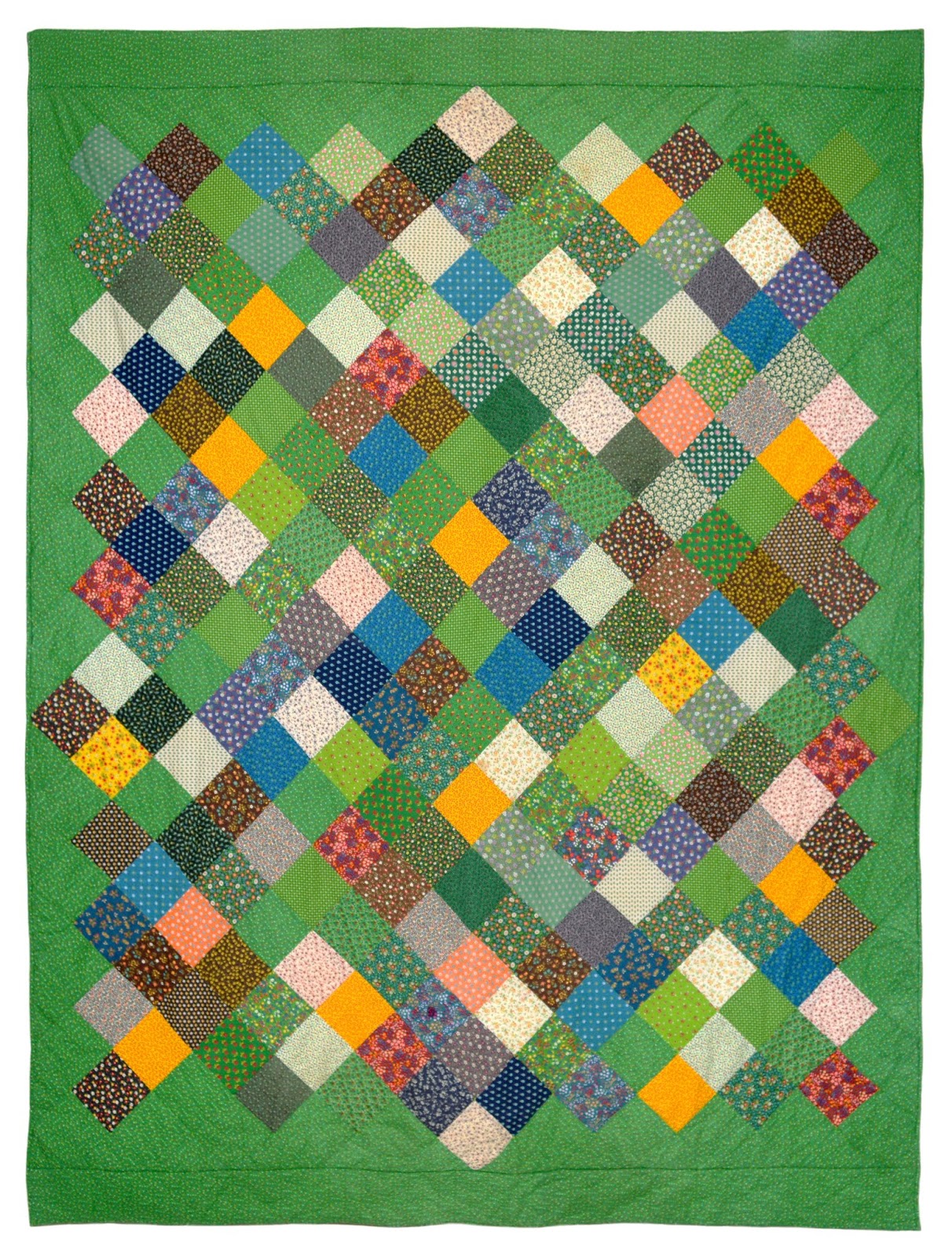
1970s cotton calico quilt, Oregon
Rebranding did not erase the sinister history of cotton in America, but it conveniently offered Americans a catch-phrase that allowed them to omit the history and land in a much happier place. When today's quiltmakers fondle the latest "to-die-for" fabrics by Kaffe Fassett and other designers of premium quilting fabrics, they do not always realize just how "to-die-for" cotton fabric in America was for much of the nation's history.
Weiss's "Green Cross Series" from 2014 commemorates
the beginning of recreational cannabis sales in Oregon.
Fast forward to present day, women (and men, and a diverse, global community) make quilts for a wide variety of reasons. I was delighted when my friend Gail Weiss commented on the "Beyond Bedding: A 'Nice, Little Hobby'" blog post. Gail is an artist, and I am fortunate to have one of her quilts in my collection. It commemorates and starts a conversation about an important current event, the beginning of recreational cannabis sales in Oregon.

"My quilting usually has nothing to do with bedding," said Weiss. "It's usually a practice in color theory with a textural aspect, specifically to work through past traumas and emotions, or simply to keep my addictive personality busy. For me, quilting is therapeutic art. Quilting is a testimonial to current events..." She recommends looking at today's political quilts. "The stories they tell are as diverse and unique as our populace... and can start many intelligent conversations about things happening right now." 
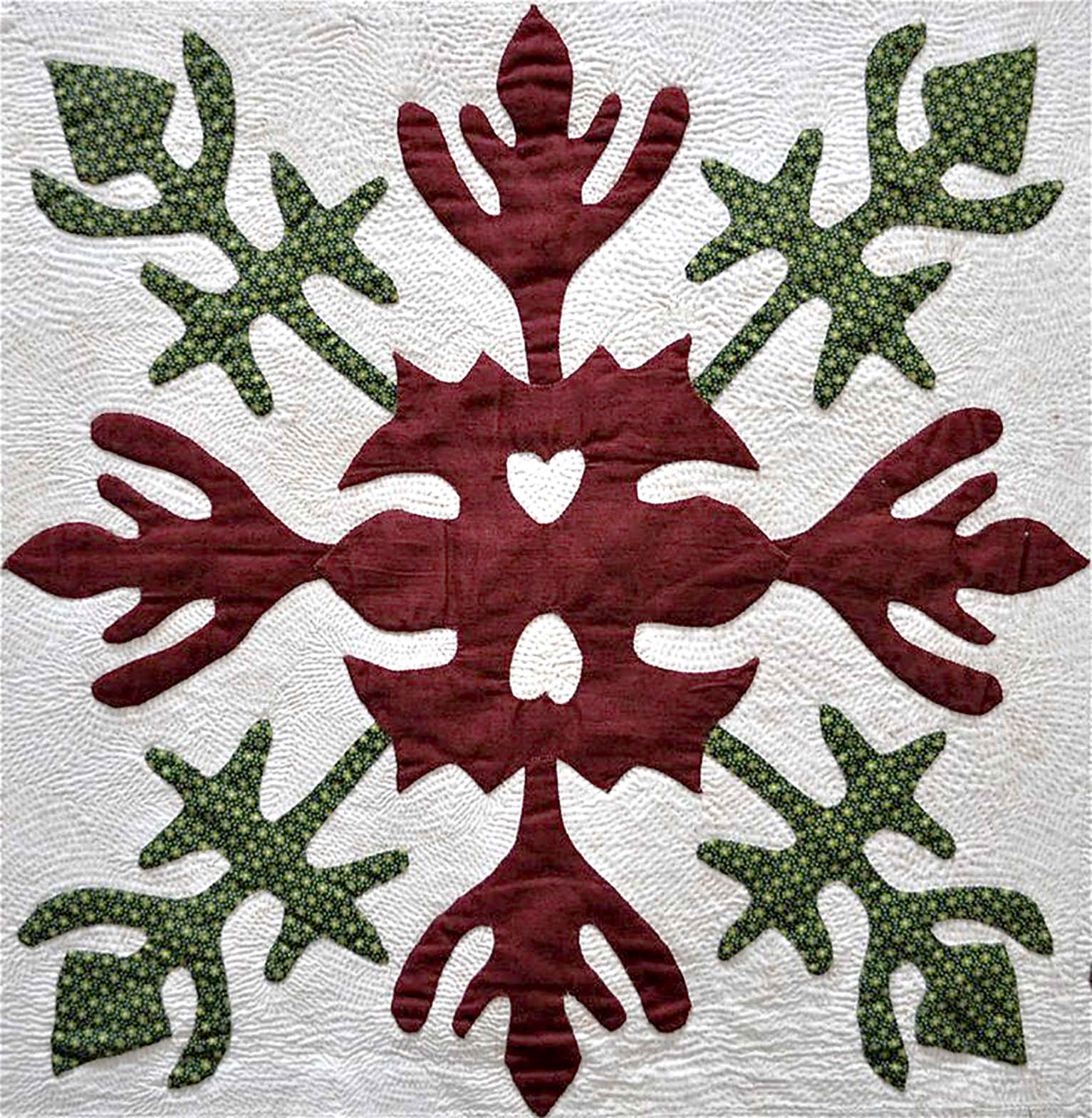
"Red" 2015 by Teresa Coates, quilted by Jolene Knight, Oregon
"Red" (2015) by Teresa Coates, quilted by Jolene Knight, is one of those conversation starters. Red represents love, war, passion, and blood; and the quilt explores the color red with elements of Pop Art, Matisse, Rorschach and traditional Hawaiian quiltmaking. It's a mash-up, and like much of the best postmodern art, it asks questions more than it provides answers.

Some people might be surprised to learn quiltmakers are actively engaged in today's hostile political climate. In my opinion, being politically savvy is to be expected of quiltmakers and others involved with textiles. History is behind us.

Friday, September 7, 2018

Beyond Bedding: A 'Nice, Little Hobby'

Rudimentary understanding of quilts suggests their sole purpose is to exist as bedding.
Quiltmaking is an exercise in absurdity, according to anyone who never had a deep thought about quilts. The silver-haired ladies have a nice, little hobby, even though they could easily go to Target, pick up a coverlet for under fifty bucks and call it good. 
"Arrangement in Grey and Black No. 1" by James McNeill Whistler
When the general public speaks about quiltmaking-- a multi-billion-dollar industry according to the 2017 Quilting in America™ Survey-- their idea of a quiltmaker is "Whistler's Mother" with needle and thread in hand. They have no idea what a computerized, long-arm quilting machine is, what it does, or what it would cost to buy one.

2018 Spring Quilt Market, Portland
Before I first explored the quiltmaking industry, I had no sense of how huge it was. I also did not realize how much quiltmaking was marginalized. A comment from a high school friend last week, which essentially said my involvement with quilts disqualified me from participating in an intelligent conversation about current events, told me exactly how much quiltmaking is commonly marginalized.

quilts may represent a "nice, little hobby" but they are
also worthy of serious academic study 

Certainly, a quilt covers the bed as part of interior decor, and it functions to provide warmth, but that's the most rudimentary understanding of the object. Quilts also document the rise of the textile industry and the creative, domestic and political endeavors of women over the course of our nation's history.


The elegant cut-out and appliqued chintz medallions attributed to Achsah Goodwin Wilkins (1775-1853) tell us about trade, religion, slavery and the road to abolition. Wilkins' was born into an Episcopalian family but married a Methodist. Her father was a wealthy merchant, and so was her husband. They were among the wealthiest families in Baltimore, but her father did not approve of her adopted religion. The family had access to the finest imported materials, such as printed chintz. 


Suffering from a cutaneous condition that affected the use of her hands, Wilkins arranged pieces of cut-out chintz fabric in fanciful floral medallions on Marseilles cloth, employing African-American women who did the sewing. It is not clear if the women were the slaves of family members or if they were freed slaves working directly for Wilkins, but their collaborative efforts were most remarkable.


The seminal quilt history book, "Old Quilts" by Dr. William Rush Dunton, includes accounts from one of Wilkins' descendants. Many of the fanciful, floral counterpanes were made, and several photos appear in the book. However, only four of them are accounted for at this time. One is in The Smithsonian, one is in Colonial Williamsburg, one is in Andalusia, the Biddle estate near Philadelphia. I found the fourth one in a 2012 Skinner auction, and later donated it to the collection of the DAR Museum in Washington, D.C. It is worth noting that Dr. Dunton, a psychiatrist, was a pioneer of quilt history as well as occupational therapy.


Isn't it remarkable how much information old bedding can offer? That's because quilts are so much more than bedding. As I said in a recent Facebook post, "Quiltmaking represents the longest unbroken chain of women's creative expression in America. An estimated twenty million quiltmakers live in the U.S. today. I suppose we can cling to the idea of crazy old spinsters fussing and toiling over unimportant, outdated handwork, but to marginalize a thriving, multi-billion-dollar industry driven by women during an age of empowerment seems unwise."

Wednesday, September 5, 2018

Why Quilts Matter, History, Art & Politics - "Eureka Moment"


The most common question people ask me about quilts is, "How did you get started collecting?" In response, I usually tell them about a guest blog post I wrote for "Why Quilts Matter, History, Art & Politics" six years ago. It's been a while since I wrote one of these guest blogs, but the question still lingers. So, I thought today would be a good day to share the link. To read more about how I got started, click here.

Sunday, September 2, 2018

The Dating Game: Quilts and Color


One way to understand American quilt history is to understand color. There was always color in quiltmaking, but the fabrics and colors evolved.

a late 18th century wool wholecloth quilt from New England

Colors often faded or changed over time. This late 18th century wholecloth wool quilt from New England was originally red, but eventually faded to brown. Brick red is evident on the underside of the top fabric, seen through a small hole in the quilt, and in the quilting thread. It could have been a brighter, more vibrant red originally.

mid-19th century, red, white and green applique quilt with orange and pink

When I first started collecting quilts almost 30 years ago, I wanted a red, white and green quilt. For some reason, I believed a quilt had to be made with those colors to be old. There was some truth to the idea. In the middle 19th century, many red, white and green quilts were made, often with hints of double pink and cheddar orange. The colors were on trend.

an 1870s tan and white pieced quilt
Sometimes an odd-looking tan color appears in old quilts. There is much debate about what color the tan may have been, but almost universal agreement that it is a "fugitive" dye, or a dye that changed significantly over time. We see a lot of quilts with this color made in the second half of the 19th century.

Victorian period jewel tones in silk

In the Victorian period, there are many dark, rich jewel tone fabrics, especially silks, satins and velvets. Silk was sometimes sold by weight, and dyes included metals which corroded and caused significant fabric deterioration. That is why Victorian crazy quilts often have shredded silks in poor condition.


soft colors in hard times, a Depression era quilt

When you see an old quilt with pastel, "Easter egg" colors, it could be from the Great Depression era. In such difficult times, it is interesting how quiltmakers often chose the most cheerful colors.

bright, saturated polyester, pure 1970s!
If you see a quilt with bright, saturated, unfaded color-- particularly if it is made of polyester-- it could be from the third quarter of the 20th century; and there's a good chance it was made in the 1970s or 1980s, when polyester was one of the most widely available fabrics.


Quiltmakers freely experimented with color, and the solution-dyed polyester resisted fading. It was the first generation of quilts that were virtually the same colors as when they were first made.


Color is one of many clues historians will use to determine the dates of old quilts. We also look at methods of construction, finishing details, and patina or signs of age. Of course, there are sometimes comparable examples with inscriptions to help us verify dates. Quilts have a tendency to say exactly what they are. That is why it's such a pleasure to work with old quilts.

Wednesday, August 29, 2018

Polyester in American Quilts

Polyester is an important part of American quiltmaking tradition. It was one of the most widely available fabrics during the great American quiltmaking revival of the 1970s, and the legacy of quilts is truly remarkable. 


The polyester formula originated in the writings of Wallace Carothers of DuPont, who is also credited with the invention of nylon in 1935. Carothers worked with a team of chemists around 1930, experimenting with the earliest form of polyester.


At the time, DuPont chose to concentrate on Nylon research. By 1945, British chemical company Imperial Chemical Industries patented Terelene polyester, known in the U.S. as Dacron. DuPont purchased the U.S. rights for further development, and later opened plants in Delaware and North Carolina to produce Dacron.


In 1951, DuPont showed a suit made of Dacron to a group of reporters in New York. The suit was worn for more than two months without being pressed. It was dunked in a swimming pool, machine-washed and surprisingly was still wearable. The fabric was wrinkle resistant and did not stretch or pucker when washed. Dacron was touted as a wonder fiber. 


Polyester double knit garments were available by 1960, and solution dyed fabrics, also known as dope dyed or spun dyed fabrics, were introduced to polyester production in 1962. In the solution dyeing process, the pigment becomes part of the fiber and the resulting fabric has excellent colorfastness.


By the 1970s, the popularity of polyester double knit garments began to decline as cottons were becoming more widely available. Quilting cottons were still scarce, and calico print fabrics used for making clothing started to appear in quilts. However, the growing interest in quiltmaking inspired people to make quilts out of what was available— polyester double knit.


DayGlo fabric was another technical innovation of the period. History from the DayGlo Color Corporation explains the origins and development of the intense, glowing colors. In the 1930s, Bob and Joe Switzer, sons of a California pharmacist, began experimentation with colors that would glow under ultraviolet or black light. By 1940, they were working on new colors that glowed in daylight. 

During the World War II era, DayGlo had military applications, such as signaling aircraft from the ground, ocean buoys and night missions. After the war, there were many more uses for DayGlo color. 


“As the chemistry and manufacturing process improved, the areas of application expanded,” according to the DayGlo Color Corporation history. “Advertising, safety and promotional firms began to recognize the uniqueness ofto recognize the uniqueness of these bright colors and specified their use.” The trademarked name DayGlo caught on, and in the late 1960s, the company officially changed its name from Switzer Brothers, to DayGlo Color Corporation.


Students of American quilt history cannot deny the importance of polyester, particularly during the 1970s. Now that the period is nearly half a century in the past, it is time to bring out the quilts, study and celebrate them.

Tuesday, August 28, 2018

The Quilt Show


Last weekend I was in Colorado to tape two segments about antique and vintage quilts for The Quilt Show with Alex Anderson and Ricky Tims.


The two segments featured quilts from my collection-- elegant, old applique quilts and modern looking antique and vintage pieced quilts.


My fiance Linda accompanied me on the journey. It was our first time sharing a quilt-related travel experience, and we had a blast. We loved meeting everyone, and hope to return again in the future. Many thanks to all the fine folks involved with The Quilt Show, and of course the enthusiastic audience. As soon as I know when the two shows will air, I will make sure to announce the dates here. Stay tuned...

Thursday, August 2, 2018

Circa Dating Old Quilts


At Spring Quilt Market in Portland earlier this year, Karey Bresenhan of Quilts, Inc., asked how I determined the dates of old quilts. The question got me thinking about the significant number of people involved with quiltmaking in America who did not know how to date quilts. So, I thought I'd write about it.


"Circa" is a Latin word meaning 'about, around or approximately' and circa dating is a method of determining an educated approximate range of dates. Typically, a circa date will list one year but encompass the period of ten years before and after the date, a 20-year range. For example, a circa date of 1860 would encompass the period from 1850 to 1870 with 1860 being the median.


My first suggestion is to become familiar with a few good books. "Clues in the Calico: A Guide to Identifying and Dating Antique Quilts" by Barbara Brackman is a good starting place. The book presents a system for dating heirloom quilts based on five characteristics-- fabric, style, color, technique and pattern.


"Clues in the Calico" offers good methods for evaluating old quilts, but when it comes to hands-on, practical application you will want copies of "Dating Fabrics: A Color Guide, 1800-1960" and "Dating Fabrics: A Color Guide, 1950-2000" by Eileen Trestain. The books include images of fabric swatches by period, as well as descriptions of the fabrics throughout history. Since a quilt can only be as old as its newest fabric, the comparable examples are especially helpful for quilt dating.


Two other books used frequently in quilt dating and documentation are the "Encyclopedia of Pieced Quilt Patterns" and "Encyclopedia of Appliqué" by Barbara Brackman. Both books include numerous illustrations of quilt block designs and published sources when available.


When using these books, it is important to keep in mind where the information originated. In the "Encyclopedia of Pieced Quilt Patterns" the published sources date mostly from the 1890s and later, which presents some challenges when it comes to applying the information to quilts made before 1890. If you want to get the most out of the book, read the references in the back.


The "Encyclopedia of Appliqué" includes more references to individual quilts, such as examples in museum collections. It documents the designs as well as the names assigned to them. Similar to the "Encyclopedia of Pieced Quilt Patterns" it does not serve as a document of what makers called their designs, although it can help with dating when looking at comparable designs.


Beyond these essentials, it is helpful to learn where other specific information can be found or which experts to ask. Recently I purchased a late 18th century quilt with two fabrics found in the "Printed Textiles" books from Winterthur. A friend and fellow collector led me to the information on one fabric and I found the other one when looking through the books.


Over the years researching individual quilts in my collection, it seemed like every conversation with a fellow quilt lover led me to purchase more books. I ended up with a large reference library, and it comes in handy each time I find an old, unidentified quilt. So, to make a long answer short, the quilts tell me how old they are, and I know what they are saying because I did my homework. That's all you have to do if you are interested in circa dating old quilts.