Tuesday, September 25, 2012

omg. Speechless.


It's here. Look at the pictures of some of the other Achsah Goodwin Wilkins quilts, and tell me this isn't one of hers!


omg. Speechless. 

Saturday, September 22, 2012

Old Quilts


Two days ago, I received an e-mail from quilt historian and noted author Merikay Waldvogel. She had seen the pictures of the Broderie Perse Chintz Medallion I'd just won in a Skinner auction, and said she thought my quilt was one of the quilts documented by Dr. Dunton in his book, Old Quilts.

"Dr. Who?" I thought to myself, typing the name into the google search box.


Dr. William Rush Dunton (1868-1966) was a psychiatrist and quilt collector from Baltimore, Maryland.  In addition to being a pioneer in the field of occupational therapy, he published books and papers, and curated exhibits of quilts. He used quilts in occupational therapy. In 1946 he self published "Old Quilts" at a personal loss of $3000. However, his efforts served to popularize Baltimore Album Quilts.


Today, Old Quilts is a collector's item and sells for at least $100 per copy. In the book, Dr. Dunton included the quilts of Achsah Goodwin Wilkins. Dr. Dunton documented 11 applique chintz medallions designed by Wilkins, which are pictured in black and white, and notes from an interview with one of Wilkins's granddaughters, Mary Dorsey Davis (1845-1939). 


Achsah Goodwin Wilkins (1775-1854) was the daughter of a wealthy merchant, William Goodwin, who had been involved with the textile trade for many years. She came from an Episcopal family but converted to Methodist and married a Methodist man, William Wilkins, Jr. (1767-1832). The family had a dry goods business, and she had great access to the best imported fabrics, with little worry about cost. 

The quilt owned by the Lassotovitch family, in color
At some point, Achsah Wilkins developed a terrible skin condition, which prevented her from sewing. It kept her awake at night, and she would spend time arranging pieces of chintz fabric as applique designs. Since she couldn't sew, she had African American women, possibly freed slaves living in her home or slaves of family members who lived nearby, who did the sewing.

It appears as though the chintz medallion I bought is one of the Achsah Wilkins counterpanes, and we think it's similar to the one owned by the Lassotovitch family, which appeared in color in Dena Katzenberg's book Baltimore Album Quilts.

We won't know for sure until Tuesday, when the package arrives at my house and I get to see the full quilt for the first time. If you look at the fern sprigs at the intersecting points of the outer swag, the inner swag and border, the center medallion and surrounding fruits and swags, and the Marseilles ground, it looks very promising.


Only three of Achsah Wilkins's applique chintz medallions are in known locations. Several of them are likely to be with descendants, but one is in the Smithsonian, another is in Colonial Williamsburg, and a third is at Andalusia. My quilt could be the fourth one to surface, and that would make it an extremely rare and wonderful thing. When I bid on it, I hoped it was decent enough to show as an example of Broderie Perse. Now, it looks as if I have unwittingly unearthed a national treasure.

A big thank you to Merikay, Barbara Brackman and Ronda McAllen for information about Achsah Wilkins and Dr. Dunton, and Lisa Ruetz for posting book plate photos on Facebook.

Cross-Currents Study #2, 1994, Andrea Balosky

Cross-Currents #2, 1994, by Andrea Balosky
Here's the second of the pair of Andrea Balosky quilts, just received from a seller in California. This quilt was made before the other Cross-Currents Study, pictured in my previous blog entry. In comparison, it seems very monochromatic, but look closely.


It's hardly monochromatic. In fact, it's quite vibrant. Another innovative, jaw-dropping quilt made in the mid-1990s by a visionary artist living right here in Oregon. Both quilts appear in Andrea's groundbreaking book, Transitions: Unlocking the Creative Quilter Within. More than 15 years after the book was first published, it is still relevant. It may be even more relevant today because now people are starting to understand her brilliance. Just like the other quilt, this one includes a remarkable variety of fabrics. Seeing it at a distance is one thing. Seeing it up close is another!

Friday, September 21, 2012

Cross-Currents Study #3, 1995, by Andrea Balosky

Cross-Currents Study #3, Andrea Balosky, 1995
The two Andrea Balosky quilts arrived yesterday, and I'm on Cloud 9! Her work just amazes me. This is one of the two quilts, Cross-Currents #3, made in 1995 in Camp Sherman, Oregon. It is the quilt on the cover of her Transitions book. When I got it up on the stand to take pictures, my mouth was hanging open in awe. Just look at the detail shots.


Such a brilliant artist! Her witty choice of fabrics, combined with an incredible sense of color, shows just how innovative her work was, and still is. It's such an elegant, sophisticated work of art. When you get up close, the fabrics are curious and very amusing. The bits of recognizable objects in the patches give the quilt an infusion of pop culture. Very, very clever, and playful!

There is one other quilt that came along with this one, and as soon as I get some pictures I'll post that one, too. Stay tuned...

Random Art Moments: Aquarium and Electric Rose

Electric Rose, 2012
Other than dinner, I don't make things too often, but lately I've had a couple of those random art moments. This week I had an idea about an electric rose growing in the garden, giving off visible electrical waves. Energy and nature. I'm thinking about making this image into a small quilt. Yesterday, I visited Pushdot Studios at their new location on Division Street, and I learned they could print on fabric.

Pushdot is where I'm getting "Aquarium" printed. They do high quality archival pigment printing, and I've been very happy with their services in the past. But it's been a couple years since I went there. They were in the old location last time I saw them.

"Aquarium" will be part of the fourth annual Spooky Show at the Lightbox Photographic gallery in Astoria. It was selected by juror Russell Joslin, owner, editor and publisher of SHOTS Magazine.

In the past, the show didn't have a guest juror, but the gallery has steadily built a reputation as a wonderful place to exhibit. It's nice to be going back for another Spooky Show. I participated in the first two years of the show but missed last year.

The last time I exhibited a print at Lightbox was the Spooky Show in 2010, and my photomontage "Zauberspiegel" received an award. It was very different from everything else in the show, and I think Aquarium will be, too.

Lightbox attracts artists who work in alternative processes, and in this day and age, traditional gelatin silver printing or anything involving a dark room and chemicals is considered an alternative process. Exhibits at Lightbox include everything from elegant platinum prints to offbeat plastic camera images.

Even though the gallery shows such a broad selection of artists, my work is something other- it's outside the box, conceptually and technically. "Aquarium", for example, is a digitally reconstructed dream. The image never existed in the real world, and was not seen by the camera or printed in a darkroom. It was laboriously assembled in Photoshop and printed on a state of the art machine.

Since I didn't get to the opening when "Zauberspiegel" was displayed, I missed seeing how people reacted to the piece, but I can imagine some folks being a little puzzled by it. "Aquarium" goes a few steps beyond. It looks like it came from another universe. This might be one of those shows where I spend some time lurking near my picture. All of these random art moments seem to have something in common. They are metaphysical. I should give some more thought to that.

Thursday, September 20, 2012

Three more AAQI Quilts

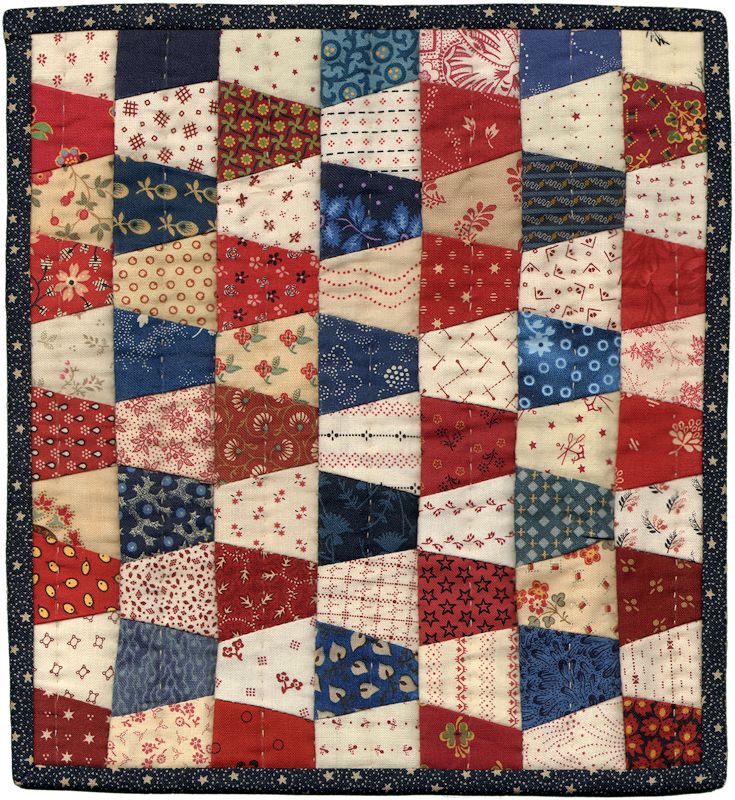
AAQI Quilt #11278, Sheridan, 2012, by Lori Dejarnatt, Kathie Holland and Gabe Owens
The other day, there was a message from Lori DeJarnatt on Facebook about the latest quilts available through the Alzheimer's Art Quilt Initiative (AAQI). I was lucky to get one of these quilts "Sheridan" - AAQI Quilt #11278. "Sheridan" is a collaborative effort. The top was cut by Kathie Holland, pieced by Gabe Owens and Lori, who lives in Madras, Oregon, and it was finished by Lori.

Sheridan appears to be a charm quilt, and I love the patriotic mix of print fabrics. This quilt really reminds me of Lori, who does some remarkable work inspired by traditional quilts. It has the feeling of an antique doll quilt, and combined with being a charm quilt, it's a very rare and wonderful thing!

#11264, Columbia Gorge at Sunset, by Barbara Sanders, Portland, Oregon
While I was looking at quilts I spotted a magical little quilt made by Barbara Sanders, who is a fellow member of the Northwest Quilters here in Portland, Oregon! The quilt is called "Columbia Gorge at Sunset" and it captures the beauty of the dramatic sunsets we see along the Gorge and elsewhere in Oregon. I love the color, the choice of fabric, the luminous thread - everything about it! And after checking the NW Quilters directory, I realized Barbara and I even live in the same zip code.

What a great surprise to discover this quilt! I've been telling fellow guild members to make these quilts so I could buy them and have their work in my collection. :) I don't know if Barbara heard me saying that, or what, but as I said to the group the last time I attended a meeting, "You make the quilts, and I will buy them!"

#11435, The Age of Aquarium, LaVerne Johnson, Cutler Bay, Florida
The third quilt was just for fun. It's #11435 and it's called "The Age of Aquarium" by LaVerne Johnson of Cutler Bay. Florida. I love tropical fish, and the title is a clever play on words, referring to the classic song "Aquarius" by The 5th Dimension. Looks like it might actually be something like Broderie Perse applique, but I'll have to wait and see it in person before I can say for sure. Love the colors and the pieced binding.

So, three winners to add to the collection, and I'm excited! For more information about the Alzheimer's Art Quilt Initiative, click here.

Wednesday, September 19, 2012

Orange Crush

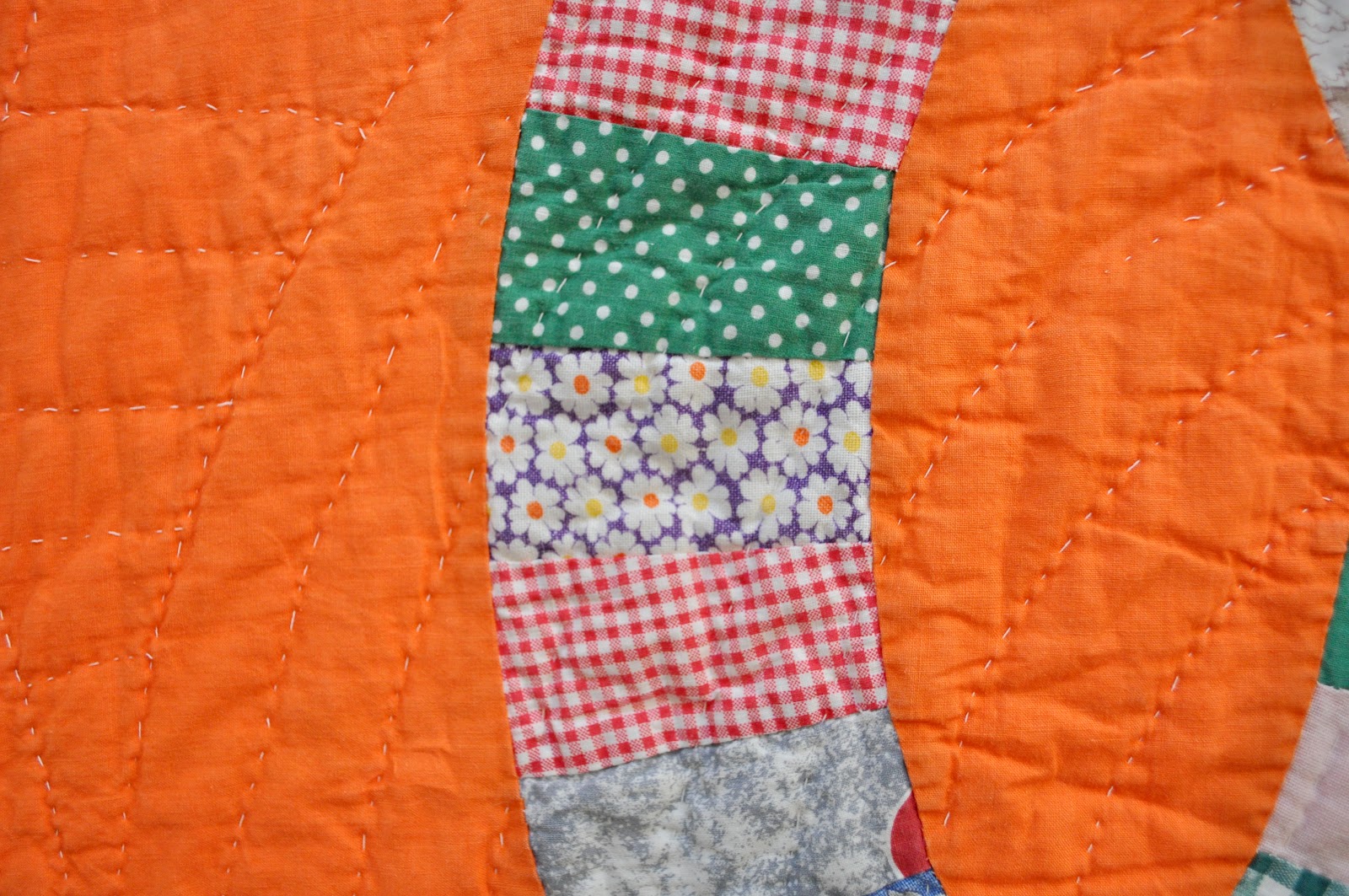
Double Wedding Ring, c. 1950, Missouri
Look what arrived on Tuesday. It's a Double Wedding Ring, and it's ORANGE!! That's something to be very excited about, in case you don't know. And it's a strong "Cheetos" orange, none of that wimpy orange creamsicle color from the Depression Era. Very rare!


Just how rare is a bright orange Double Wedding Ring? A search of the Quilt Index produced 1368 results using the term "Double Wedding Ring". A few of those, maybe a half dozen, were cheddar orange- a more yellowy color. There was really nothing that compared to this color orange. I looked through Robert Bishop's "The Romance of Double Wedding Ring Quilts" and found one cheddar orange out of more than 60 quilts, but no "Cheetos" orange.


It's the color of the old Denver Broncos, the Orange Crush, and I have a crush on this quilt! My new nickname for it is "Orange Crush". There are 40s and 50s fabrics, so I think it's c. 1950. Quilted in fans, or elbow quilted - very much utility quilting. It's the second rare colored Double Wedding Ring I've collected. The first was a blue one, and a Quilt Index Search produced less than a half dozen of those.


What can I say? A white Double Wedding Ring is beautiful, but common. There are thousands of them. I like 'em rare, and "Orange Crush" and the blue Double Wedding Ring are about as rare as they come.