Friday, December 3, 2010

Four Circular Vine Blocks

Circular vine with grapes, top row, second block from the left
Today's blog is the second in a series of blogs featuring blocks from the Album with Lyre Medallion, and circular vines is the theme. The quilt includes four blocks with circular vines, and each block is unique in its combination of botanical elements. The first block is from the top row, second from the left, and includes leaves and triangular bunches of multicolored grapes in green, cheddar orange, and oxblood/burgundy.

Circular vine with apples and strawberries, third row, left side
The second block may be familiar to those who follow my blog. I've included it in more than one blog in the past. This block is from the third row, far left, and includes leaves, apples and strawberries in two colors. It is one of my favorite blocks because of the way the apple stems seem to bend with the weight of the fruit.

Circular vine with simplified Roses of Sharon, no centers, and buds
The third block is also from the third row, far right. It is made with two-colors and includes Roses of Sharon, simplified without center circles, and buds that look ready to burst open. This circle is a clever solution to the problem of creating an applique circular vine. It is made in pieces with the flowers hiding the breaks in the vine. The wreath is flanked by opening buds and leaves in all four corners of the block.

Circular vine with a selection of summer and fall fruits
The last of the four blocks is from the bottom row, center, and would make a pretty good pie - or two! The wreath includes pears in yellow and green, plums, and strawberries. Small leaves balance nicely with chain stitched stems and the larger open space in the center of the circle. In this block, as in the other three, the applique stems or vines are about 1/4" wide.

Yesterday I posted a link to my blog on the American Quilt Study Group Yahoo Group, and someone asked about whether or not I would make patterns available for this quilt. It's not the first time I've been asked, but my response has remained the same. I don't mind if quilt makers want to study the quilt by recreating parts of it, or even the whole thing with the correct attributions. However, I am not planning to make a published pattern available. In my way of thinking, keeping it out of mass production and the world of commerce is a way I can maintain its status as a unique work of art.

Thursday, December 2, 2010

Four Exquisite Flower Pots

Flower pot block from the upper left corner of the quilt
Liz, one of my Blogger friends from Sydney, New South Wales, Australia, suggested I blog about the quilt blocks from the Album with Lyre Medallion, so today I'm starting with four exquisite flower pot blocks seen in each of the four corners of the quilt. These blocks are facing sideways when the quilt is hanging upright, so I've turned them upright for easier viewing.

Mary Couchman Small (1800-1863) of Martinsburg, Berkeley County, West Virginia made this quilt around 1850. It was a mother-daughter project. Mary's daughter, Harriet, who was about 14 at the time, made a second quilt using the same fabrics, many of the same block designs, and same technique. In October, I blogged about both of these quilts and their connection.

Flower pot block from the upper right corner of the quilt
The family lived on a farm, approximately 100 miles west of Baltimore. I was surprised to learn that they lived on a farm. The quilts seem to speak more to a life of affluence and refinement than to my idea of life on a farm. It's not a scrappy, utility quilt. The fabrics were most likely purchased new, and the handwork is extremely fine. I was less surprised to learn about the family's proximity to Baltimore. The quilts are clearly related to the tradition of Baltimore Album quilts. They've been called "country cousins" - but I think that's selling them a little short.

Flower pot block from the lower left corner of the quilt
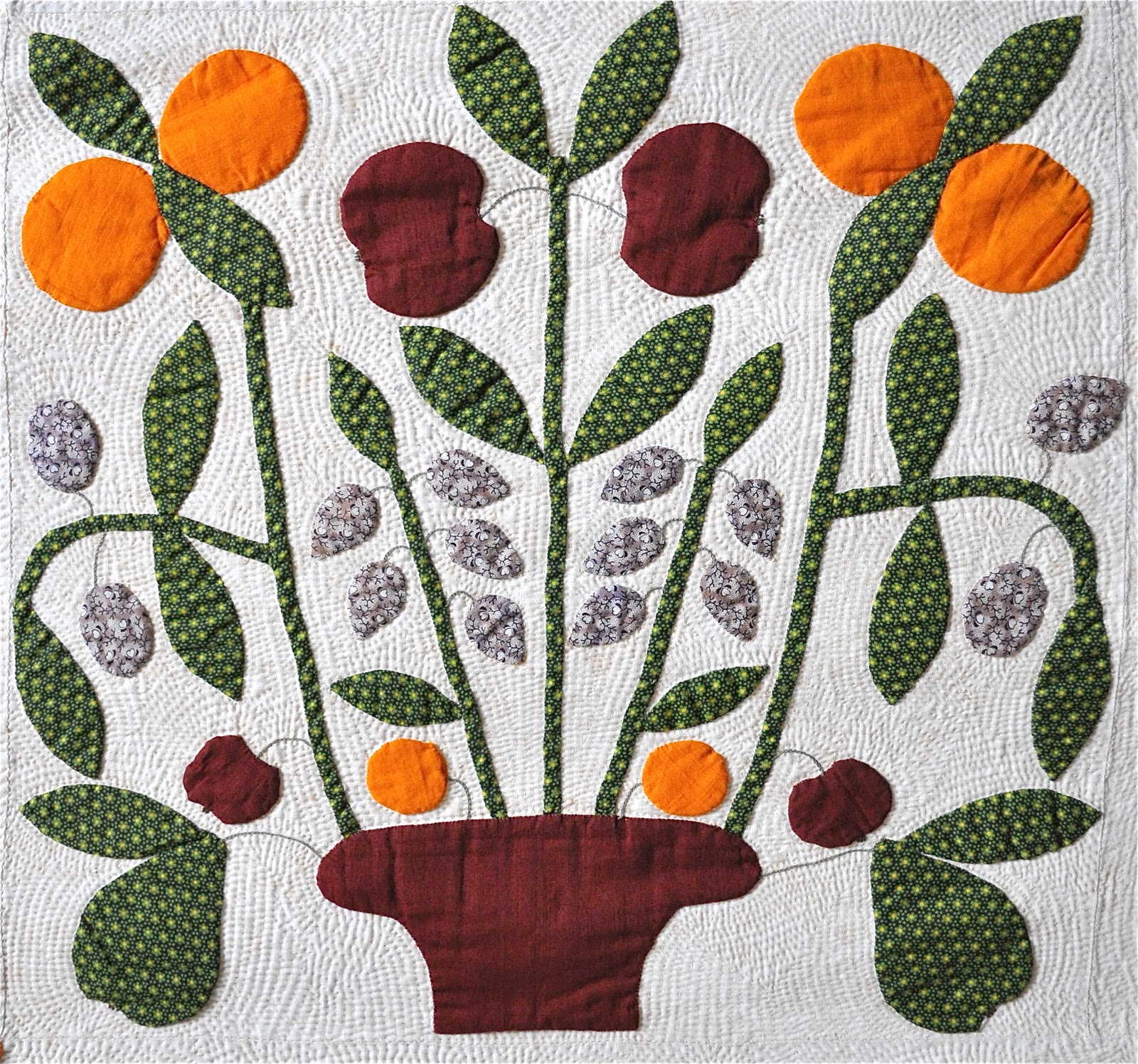
The four flower pot blocks include a variety of flowers and fruits - lilies, roses, bluebells, apples, cherries, lemons, strawberries, and even a pineapple! While the surrounding white background fabric is densely quilted with a free-form style of echo quilting, most of the applique is not quilted, which creates an effect almost like trapunto. Fabrics include a fairly common over-dyed green floral print, cheddar orange, an "oxblood" maroon or burgundy, and a lavender floral print.

Flower pot block from the lower right corner of the quilt
One of my favorite details about these four exquisite flower pot blocks is the delicate chain stitch embroidered stems, so finely done you almost need a magnifying glass to examine them, and the stitched detail at the undersides of the apples. The tiny applique stitches are also pretty amazing. Thank goodness for macro photography!

Macro view of cherries and apple with embroidered embellishments
So, Liz - thank you for the suggestion. I always love spending time with this quilt, and I hope you enjoyed the four flower pot blocks. This quilt is never boring for me, and I'm glad other people are as intrigued with it as I am. Will post more soon!

Wednesday, December 1, 2010

Afternoon at the Beauty Parlor


Today Ronda Beyer visited me, and I was ready with quilts draped all around the house. The living room was decked out with a bunch of my New York Beauty / Rocky Mountain Road / or whatever-you-want-to-call-them quilts, and I said to Ronda, "I bet you didn't realize I was taking you to the beauty parlor today." By the way, Ronda didn't need to go to an actual beauty parlor - she looked like a model - what a beautiful lady! Still, the quilts were the center of attention.


Ronda arrived a minute or two before I got back from the market. I needed to get a carton of milk, just in case we had coffee. She brought be a beautiful Christmas tree shaped Rosemary plant (thank you, Ronda!), and I greeted her with quilts in the entry way. She definitely has a good eye for quilts, and made a beeline to the bannister separating the dining room from the living room, where five of my "best-of-kind" quilts were hanging. 


We admired the wonderful hand quilting, and I told stories about collecting and what I've learned along the way. We walked to the guest room and looked at the colorful Lucy Mingo quilt from Gee's Bend, which lit up a mostly monochromatic room. Eventually, we made our way upstairs where the star of the show - the 1850 Album with Lyre Medallion - was hanging on a quilt rack in the loft. Even though Ronda admitted she wasn't the biggest fan of machine echo quilting, she was most impressed with the echo hand quilting on the Album quilt. It is truly mind-boggling.


We found ourselves in the master bedroom - not what you think - again, it was all about the quilts! There, I had some of the oldest quilts in my collection - also among the oldest quilts here in Oregon - and some other very interesting examples. I think we looked at thirty or forty quilts throughout the house. One of her favorites was a surprise to me. It was a rescue quilt from the 1830's, made in Tennessee. Even though the quilt is in very rough condition, we were both struck by its charm. She said she'd like to recreate it some day, and that I'd love to see! I think she'd do an amazing job.


We ended up in the kitchen, and shared stories about our experiences and some of the people we've met in the world of quilts, and soon she was on her way. I had a great time, and it was really the first time I'd had quilts on display all around the house, over the furniture, on walls, and on beds. It reminded me of the first quilt showing I attended more than 20 years ago, when I met Shelly Zegart. That day, Shelly had quilts displayed all over the furniture. It was nice to take a page out of her book.

I think I'll keep the quilts out for a few more days. They make me happy, and it'll give me good reason to invite more friends over for a repeat performance.

Tuesday, November 30, 2010

Preparing for a Noteworthy Guest

Hand quilting is the theme for tomorrow's visit with Ronda Beyer.
One of the best machine quilters in the world, Ronda Beyer, is coming to visit tomorrow. We're going to look at quilts, and I've been doing a little light housecleaning and pulling out some old quilts to share. Ronda recently won second place in the Merit Quilting, Machine category at the International Quilt Festival in Houston for her quilt, "Darwin's Diamonds and Flowers" and was one of several Oregon quilters to receive an award.

Quilt Making runs in the family for Ronda. Her grandmother was a well-known quilter, and her mother, Jane, first opened a quilt shop in 1981. Jane's Fabric Patch is located in Tillamook, Oregon, also home of the Latimer Quilt and Textile Center. In 2004, Ronda purchased a longarm quilting machine, and from there, here career took off. Recently, she mentioned that she started out as a hand quilter, something I didn't know. It is her machine quilting she's best known for these days.

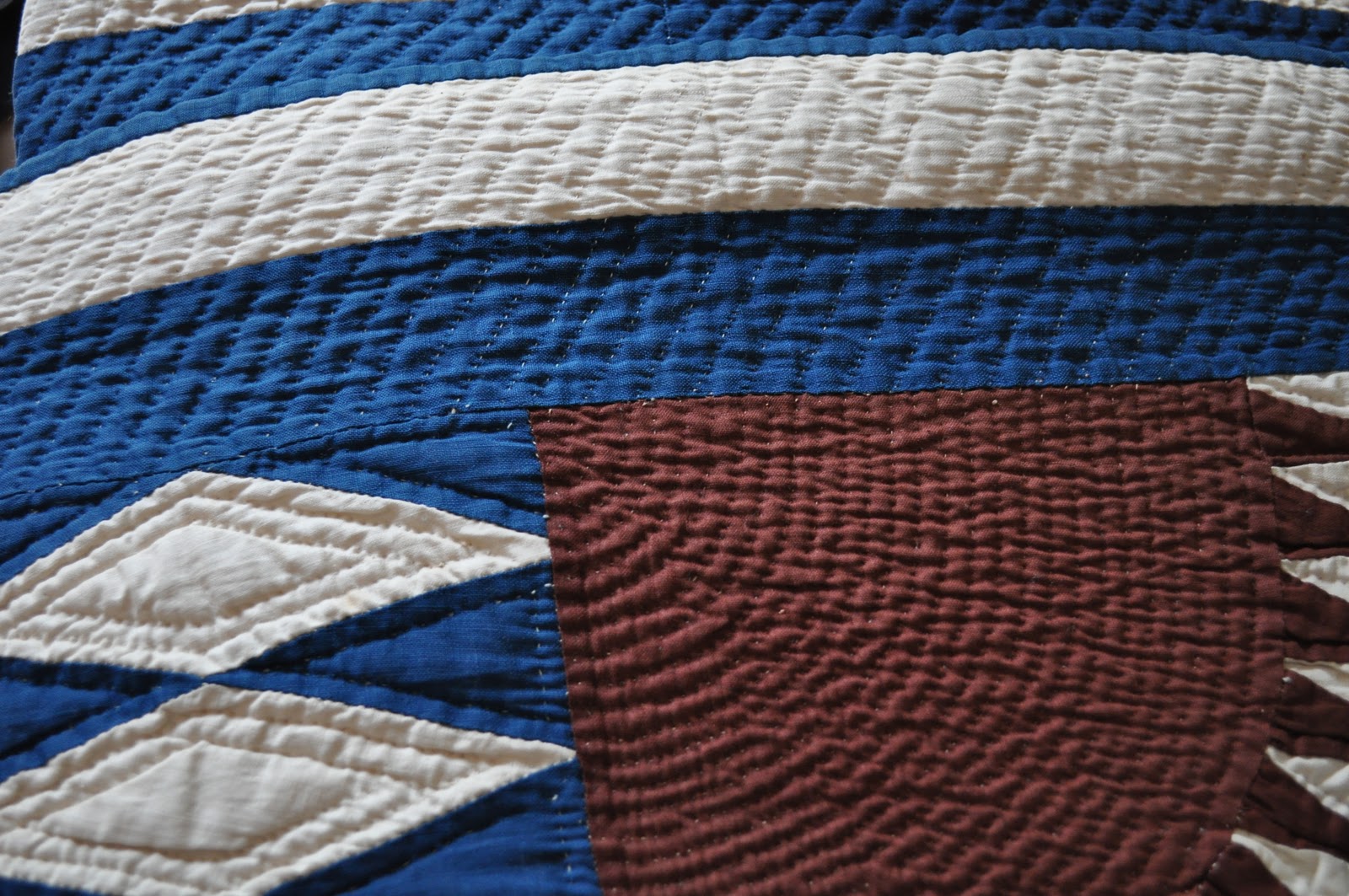
Detail of Album with Lyre Medallion - the quilting is insane!
When I first saw quilts that were machine quilted about a decade ago, I frankly wasn't all that impressed. The squiggly, wavy-line "stipple" quilting seemed kind of cold to me, and I was unsure if machine quilting could ever be considered a form of artistic expression. That all changed the first time I saw Ronda's work. It's absolutely incredible, and she has convinced me that machine quilting truly is an art.

The first quilt I ever bought features great piecework and amazing quilting.
I've known about Ronda's work for a few years, and finally got to meet her in person this year at the Northwest Quilt Expo in Portland. At the time, I said I wanted to share some quilts with her, particularly the Album with Lyre Medallion made by Mary Couchman Small in 1850 and some of my "New York Beauty" Rocky Mountain Road quilts. Ronda and I have been in touch through Facebook, and I'm simply delighted we're going to have a visit tomorrow. I'm just in awe of her work, and happy that I can share some quilts that I know she'll enjoy.

Thursday, November 25, 2010

Are you in the kitchen?

2008: my kitchen was remodeled. This is one of the "after" shots.
I have a feeling I know where many of you are today - in the kitchen. That's not a bad place to be on Thanksgiving Day. This year, my friend Roberta has invited me to dinner. I always love a good home-cooked meal, but won't be spending as much time in my kitchen as usual. Although I'm planning on making a big pot of stock and Ina Garten's famous French Onion Soup over the weekend, today my kitchen will get the day off. Not cooking on Thanksgiving made me realize I've become very attached to my kitchen since remodeling it two years ago.

2000: A "before" shot of the kitchen, as it looked just before I moved in.
The house was built in 1980 in the hilly northwest Cedar Mill neighborhood of Portland, and when I moved in the kitchen was workable but in need of an update. Many of the appliances, including a scuzzy Jenn-Air cooktop, were original to the house. The cabinets, floor, and countertops had been redone at some point, but it wasn't really my style. There was bad fluorescent lighting, whitewashed oak cabinets that looked pink, a white linoleum floor with little pink flowers - impossible to keep clean - and difficult-to-maintain gray tile countertops with dusty rose and teal accent tile. 

I made do for a while, and after many years of watching the Food Network and HGTV, I had some ideas about what I wanted to do. I decided to have the space remodeled in 2008, and it was a dramatic transformation. In July, the whole space was gutted to the beams. Windows were removed, the floor plan flip-flopped, new windows and doors were added, and all new appliances, cabinets, countertops and floors were installed. The whole project took about three months from demolition to move-in.


The new floors are hickory, the cabinets are maple, and the appliances are all stainless steel. The countertops are two types of granite, backsplash is slate with bronze and frosted glass accents, and the way we reconfigured the the floor plan really opened up the space. The remodel was actually more like a half-house remodel and included the dining room, front foyer, powder room, roof, a new heating and air conditioning system, and entertainment area connected to the kitchen. There is a built-in desk and bar with cabinets, a whole wall with bookshelves, gas fireplace, and plasma TV, and a large wall designated for displaying quilts.

In 2009, the remodel was showcased on HGTV's Rate My Space with Angelo Surmelis. In 2010, the house was featured as part of Portland's Tour of Remodeled Homes, and was highlighted on the local morning news in two segments of "Out and About with Drew Carney" on KGW channel 8, Portland. 

The remodel was a game changer. I can cook most anything I want, from Spanakopita to homemade thin crust pizza to braised pork shoulder roast carnitas. I've even roasted a turkey or two. It's a dream kitchen, easy to work in and easy to clean. So, while today may be a quiet day in my kitchen, it has served me well and definitely deserves a day off. Happy Thanksgiving!

Monday, November 22, 2010

For Lyn Foster


I am dedicating today's blog to Lyn Foster, treasurer of the Oregon Quilt Project, whose husband unexpectedly passed away on Saturday morning. Lyn is so much more than a treasurer to us. Simply put, she is a treasure. In addition to being a highly capable volunteer, she has been one of my biggest supporters as I've joined the "quilt ladies" here in Oregon. Wherever we've traveled with the group, she's always had smiles, hugs, and very kind things to say. 

Lyn absolutely loves old quilts. This quilt arrived on my doorstep today, a day spent thinking about Lyn, and now it will always remind me of her. I first found out about this quilt a few weeks ago when corresponding with a long lost swimming friend, Priscilla Kawakami of Salt Lake City, Utah, who happens to be an extraordinarily good quilt maker. 

It's been wonderful reconnecting with Priscilla, and our correspondence has evolved from primarily swimming to quilts. Priscilla knew me when I had just two quilts, and I stayed at her home when driving across the U.S. from New Jersey to my new home in Oregon. One of the few things I brought with me was my first "New York Beauty" quilt. Here is where I should say that the quilt, from the mid 19th century, is more correctly called a Crown of Thorns or Rocky Mountain Road.


During a recent e-mail exchange, Priscilla mentioned that Stella Rubin had advertised a great "New York Beauty" quilt in Antiques & Fine Art Magazine. I dropped everything, got in the car, and headed to Powells to find the magazine, but they didn't have it. I went to another shop, Rich's, which is a tobacco shop with a wide selection of magazines, and they didn't have the most recent issue yet - so I called Stella. Within the day, I had arranged to purchase the quilt.

I was immediately drawn to the quilt, just as I was drawn to Lyn at the Columbia Willamette Quilt Study Group meeting a year ago. Lyn approached me and introduced herself after I showed a Mariner's Compass from New Jersey, not far from where she was married. We've been friends ever since then.

This quilt is from Kentucky, made in the latter half of the 19th century, and is a very rare example. I've only seen three or four others with the vine sashing. It's appropriate that the quilt now reminds me of Lyn, because she is also very rare. She adopted me like a son at a time when I was just making my way into the mostly women's world of quilt history, and she's always been very supportive and made me feel welcome. 

Lyn Foster
So Lyn, this one's for you. My heart goes out to you and your family during this very difficult time. I hope this quilt brings a smile to your face, as you've always done for me.

Friday, November 19, 2010

Four Quilts from The Esprit Collection

Crib Quilt was once part of the Esprit Collection
My collection has a connection to Esprit. Following the arrival of the quilt featured in yesterday's blog, I realized I had four quilts that were once part of the Esprit Collection. Two are Amish, and both are unusual examples because of size. The other two are high-style quilts made from the pattern known as New York Beauty, and both are exceptionally high quality.

The Esprit Collection, curated by Julie Silber for many years, originated when Doug and Susie Tompkins owned Esprit and decided to decorate the headquarter with quilts. The richly saturated colors and bold, broad patterns in Amish quilts seemed symbiotic with the Esprit clothing line. The collection is best known for richly saturated Amish quilts, many of which are now part of the Heritage Center Museum of Lancaster, Pennsylvania. Over the years, the emphasis of the collection evolved, and occasional deaccessions allowed a few lucky collectors to get a small piece of Esprit.

I may be one of the luckier ones. Although four quilts is not a lot, I think the quality more than makes up for lack of quantity. Both of the Amish quilts came from a California eBay seller who had bought them from Susie Tompkins years earlier. There were a few others for sale at the time, but I couldn't afford all of them, so I decided to go for the two small quilts.

Trundle size Tumbling Blocks quilt
I think it was a good choice. When I flipped through "Amish: The Art of the Quilt" and "The Esprit Quilt Collection" catalog, I didn't see pictures of any crib or trundle quilts. I'll have to read through the collection notes more carefully to see how many crib and trundle quilts they had. My guess is not many. The larger, mostly square quilts worked well on the large, exposed brick walls at Esprit. They commanded the space.

Together again!
Most quilt people know about the Esprit Amish quilts, and many have also heard about how the collection evolved toward "Maverick" quilts. What you may not know is Susie Tompkins has also collected classic, masterpiece quilts. These two "New York Beauty" quilts were both part of her collection, and happily, they're still together in my collection.